|
|
|
|
|
|
|
|
When Cooking Dinner Feels Harder Than Running a Ward
Exploring Disability, Employment, Independence and Long Covid for Healthcare Workers for Healthcare Workers
|
- Disability Pride Month: Identity, Independence and Long Covid
- Living with Long Covid: Finding a New Normal (Guest contribution from Demilola Yusuf).
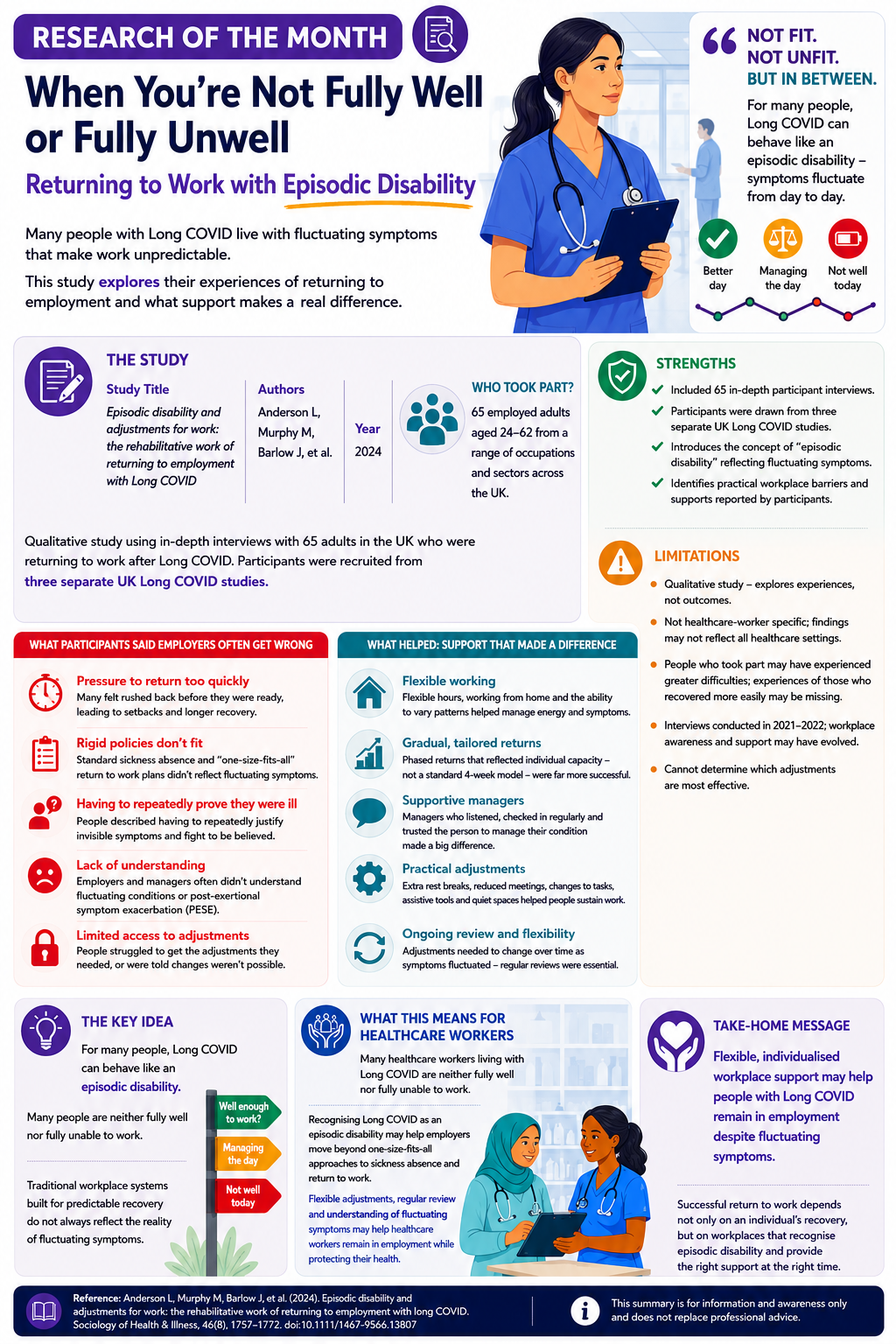
- Research of the Month
- Mid-Year Long Covid Research Update
- Emerging Policy Developments Affecting Healthcare Workers
- Help shape SHH-UK's Position Statement
- Peer Support Corner
- Meet the Volunteer
- Ways to Get Involved
|

|
|
|
Disability Pride Month: The Hidden Impact of Long Covid on Daily Life
Healthcare workers are accustomed to managing busy wards, caring for patients, making critical decisions and supporting families through some of life's most difficult moments. Yet for many living with Long Covid, everyday activities such as cooking dinner, carrying shopping, helping children with homework or completing household chores can become exhausting challenges.
|
As Disability Pride Month encourages us to recognise and celebrate the experiences of disabled people, it also provides an opportunity to acknowledge the realities faced by healthcare workers living with Long Covid. Disability is not always visible, and its impact is not limited to the workplace. For many, the greatest challenges occur in the ordinary moments of daily life that others may take for granted.
|
The contrast between what healthcare workers once did professionally and what they are now able to do at home can be both physically and emotionally difficult. A nurse who once worked twelve-hour shifts may now need to rest after preparing a simple meal. A doctor who managed complex clinical decisions may struggle to concentrate long enough to complete routine household tasks. An allied health professional who spent their career supporting others may find themselves relying on family and friends for help with everyday activities.
|
Research shows that Long Covid can significantly affect activities of daily living, with people reporting increased effort, fatigue and reduced independence when carrying out routine tasks such as meal preparation, shopping and household management. Tasks that were once automatic can require careful planning, pacing and recovery time.
|
For healthcare workers, these limitations can be particularly distressing because they often represent more than a loss of physical function. They can affect identity, confidence and independence. Many healthcare professionals are used to being the person others turn to for support. Needing assistance with everyday tasks, or having to choose between attending a family event and having enough energy to prepare dinner later that day, can be emotionally challenging.
|
Disability Pride Month is not only about recognising rights and promoting inclusion. It is also about acknowledging the diverse ways people adapt, contribute and continue to find meaning despite significant challenges. For healthcare workers living with Long Covid, independence may look different than it once did. Success may be measured not by a return to previous levels of productivity, but by learning new ways to work, participate and care for themselves while managing an often unpredictable condition.
|
Recognising these experiences helps create more compassionate workplaces, stronger support networks and a broader understanding of what living well with disability can mean.
|
The challenges of Long Covid do not stop at the hospital door. They affect daily life, independence and identity. But these experiences are not unique and growing evidence is helping us better understand them.
|
|
While research is helping us better understand the impact of Long Covid on daily life, the lived experiences of those navigating these challenges every day remain equally important. In the following article, volunteer contributor Demilola Yusuf reflects on adapting to Long Covid, finding a new normal, and the importance of support, understanding and inclusion.
|
|
|

|
|
Living with Long Covid and Finding a New Normal
Long Covid has changed many lives in ways that are not always visible. Some people have had to reduce their working hours, take time away from work, or rely on support they never needed before. Others may look fine on the outside, but every day now involves planning, pacing and careful use of limited energy.
|
One of the biggest changes is how ordinary activities can become difficult. A trip to the shop, a journey to work, a family visit or even a long conversation can leave someone exhausted. Many people now have to ask themselves, “If I do this today, how will I feel tomorrow?” That question alone shows how much life can change.
|
For healthcare workers, this can be especially hard. Many were used to caring for others, working under pressure and pushing through tiredness. Long Covid can change that completely. It can affect confidence, identity, work and independence.
|
The workplace is one area where support matters greatly. Flexible hours, working from home, phased returns, extra breaks and adjusted duties can help people remain in employment. But support should not only exist on paper. People need to feel believed, respected and safe enough to ask for help without being judged.
|
There is also the financial pressure. Reduced income, sickness absence and uncertainty about work can place a heavy strain on individuals and families. Trying to understand benefits, workplace policies or Access to Work can also be exhausting for someone already dealing with fatigue and brain fog.
|
Long Covid also reminds us that disability is not always visible. Someone may manage one task today and struggle with the same task tomorrow. That does not mean they are exaggerating. It means their condition can change from day to day.
|
Disability Pride Month is a useful reminder that inclusion should be practical, not just spoken about. People living with Long Covid need understanding, flexibility and fair treatment.
|
Many are not giving up. They are adapting, rebuilding their lives and finding new ways to cope. Sometimes resilience is not about pushing through. Sometimes it is about resting, asking for help and moving at a different pace.
|
|
No one should have to face these changes alone. A new normal is easier to find when people are listened to, believed and supported.
|
|
|
|
|
|
|

|
Research, Policy and Practice: What Has Changed in 2026?
Five years after the start of the pandemic, Long Covid remains a significant issue for many healthcare workers. While researchers continue to investigate the biological mechanisms underlying symptoms, increasing attention is being paid to how people participate in work, family life and society.
|
Long Covid is increasingly being discussed through a disability lens
Research is moving beyond symptom lists to explore how Long Covid affects participation, independence and quality of life. Concepts such as episodic disability are gaining attention because they help explain why many people experience fluctuating symptoms and varying levels of function from day to day. This shift reflects growing recognition that disability is not always visible and that support needs may change over time.
|
Employment support is becoming a bigger policy issue
Across the UK, policymakers are paying increasing attention to how people with long-term health conditions can remain in work. The Government's Keep Britain Working Review has highlighted rising economic inactivity associated with ill health and the need for improved support to help people stay in or return to work. Recent discussions have focused on workplace adjustments, flexible working and sustainable employment for people living with long-term conditions. Gov.uk
|
The conversation is shifting from "Can people work?" to "What support do they need?"
There is growing recognition across occupational health, disability advocacy and employment policy that sustainable employment often depends on flexibility, understanding and tailored support. Guidance from the Royal College of Nursing highlights the importance of reasonable adjustments, phased returns to work, flexible hours, occupational health support and regular review of support needs for staff living with Long Covid. Royal College of Nursing
|
Why This Matters
The emerging message from research, policy and practice is clear: recovery is not only about health. It is also about creating workplaces and communities that enable people to participate in ways that are sustainable for them. This includes flexible support, reasonable adjustments, supportive workplace cultures and healthcare environments that are designed with staff and patient wellbeing in mind (including initiatives such as SafeAir4All that advocate for safer indoor air in healthcare settings). For healthcare workers living with Long Covid, this means ensuring that support, understanding and flexibility remain central to discussions about employment, inclusion and workplace wellbeing. Gov.uk
|
- UK Government. Keep Britain Working Review – March 2026 Update (Gov.uk)
- UK Government. Keep Britain Working: Final Report (2026) (Gov.uk)
- Royal College of Nursing. Supporting Staff Who Are Living with Long Covid. (Royal College of Nursing)
- Society of Occupational Medicine. Long COVID: A Manager's Guide (2024). (SOM)
|
|
|
|
|
Help Shape SHH-UK's Position Statement
SHH-UK is developing a Position Statement outlining the support needs of healthcare workers living with Long Covid.
|
To help ensure the final statement reflects real-world experiences and priorities, we are seeking feedback from healthcare workers living with Long Covid about the challenges they face and the support they believe is most urgently needed.
|
Whether your experiences relate to healthcare, employment, financial wellbeing, workplace adjustments, daily living, or accessing support, we would love to hear from you.
|
We will be gathering feedback through conversations, drop-in sessions and other accessible engagement activities to ensure the voices and experiences of healthcare workers remain central to future discussions about Long Covid support, employment, workplace adjustments and inclusion.
|
If you would like to share your experiences, contribute to this work, have any questions about the project, or would prefer to provide feedback by email, please contact Erin Whittingham at erin.whittingham@shh-uk.org.
|
|
Together, we can help ensure that the voices and experiences of healthcare workers remain central to future discussions about Long Covid support, employment, workplace adjustments and inclusion.
|
|
|
|

|
Meet the Volunteer: Katie Redfern
Katie Redfern joins SHH-UK as our Volunteer Coordinator. She has over 20 years of experience across the HR, recruitment, and coaching landscape. Her background includes working as an HR Manager and founder of Meaningful Recruitment. In these roles, she developed a solid foundation in talent management, HR policy, and large-scale recruitment. She has delivered these services for global organisations, B Corporations, and various charities, including the National Youth Ballet.
|
She is deeply passionate about supporting organisations and frontline services that do good in the world. She is particularly proud of the support she has given to healthcare and medical research-focused groups, including SUDC UK and Action Medical Research.
|
|
Having played an active role in her business community during the pandemic, Katie has worked closely with key workers, especially teachers, facing the difficulties of Long Covid. She is highly motivated to use her extensive skills in her role at SHH-UK to build and nurture ongoing volunteer engagement, and she looks forward to seeing the volunteers' collective efforts positively impact those in need.
|
|
Meet the Volunteer: Katie Redfern
Katie Redfern joins SHH-UK as our Volunteer Coordinator. She has over 20 years of experience across the HR, recruitment, and coaching landscape. Her background includes working as an HR Manager and founder of Meaningful Recruitment. In these roles, she developed a solid foundation in talent management, HR policy, and large-scale recruitment. She has delivered these services for global organisations, B Corporations, and various charities, including the National Youth Ballet.
|
She is deeply passionate about supporting organisations and frontline services that do good in the world. She is particularly proud of the support she has given to healthcare and medical research-focused groups, including SUDC UK and Action Medical Research.
|
|
Having played an active role in her business community during the pandemic, Katie has worked closely with key workers, especially teachers, facing the difficulties of Long Covid. She is highly motivated to use her extensive skills in her role at SHH-UK to build and nurture ongoing volunteer engagement, and she looks forward to seeing the volunteers' collective efforts positively impact those in need.
|
|
Peer support groups: You're Not Alone
SHH-UK peer support groups provide a safe, confidential space for healthcare workers living with long covid to connect, share experiences, and support one another. Our groups are facilitated by SHH-UK volunteers and are open to all healthcare workers affected by Long Covid.
|
Please email supportgroup@shh-uk.org if you have any questions, or you would like us to send you a reminder, the day before each peer support group meeting.
|
Upcoming Peer Support Groups
☕ 💬Coffee and Chat
Tuesday 14th July at 11:00am
An informal space for healthcare workers living with Long Covid to meet, connect and chat. You can join by clicking here.
|
|
Tuesday 28th July at 11:00am
|
An informal space for healthcare workers living with Long Covid to meet, connect and chat. You can join by clicking here.
|
🌙 🤝Evening Peer Support Group
Thursday 6th August at 7:00pm
For healthcare workers living with Long Covid who are working or planning a return to work. The focus of this session will be chosen by participants attending the July evening peer support group. You can join by clicking here.
|
|
|
|
|
What You Can Do
|
Whether you are living with Long Covid, supporting someone who is, or simply want to help make a difference, there are many ways to get involved with SHH-UK.
|
📝 Share your story
Help others feel less alone by sharing your experiences of Long Covid, work, family life or recovery.
|
🤝 Join a peer support group
Connect with other healthcare workers who understand the challenges of living with Long Covid.
|
🔬 Take part in research
Contribute to research opportunities that help improve understanding of Long Covid and its impact.
|
🌬️ Support SafeAir4All
Help us advocate for safer healthcare environments and improved indoor air quality for staff and patients.
|
📚 Share SHH resources
Help us reach more healthcare workers by sharing our resources, newsletters and campaigns with colleagues, friends and networks.
|
|
Together, we can raise awareness, improve support and ensure healthcare workers affected by Long Covid are heard.
|
|
|
Thank You
Thank you to everyone who has shared their experiences, contributed content, supported our work, attended a peer support group or helped raise awareness this month.
|
Every story, conversation and contribution helps make a difference.
|
|
Together, we can continue to learn from one another, support one another and ensure that no healthcare worker faces Long Covid alone.
|
|
|
|
     
|
|
This newsletter is intended for information and support purposes only and should not be considered medical, legal, occupational health or financial advice. If you have concerns about your health, employment or personal circumstances, please seek advice from an appropriately qualified professional.
|
|
Some articles, illustrations and infographics in this newsletter were created using AI-assisted tools and reviewed for accuracy by the SHH-UK team before publication.
|
|
Supporting Healthcare Heroes UK is a registered charity in England and Wales (Charity No. 1205685).
|
|
|
|
|
|