|
|
|
|
|

|
|
|
|
|
|
Who cares for the carers?
In This Issue
🧡 Featured Story
Andrea's story: From Midwife to Bedbound
|
💙 Carers Week Feature
When the Caregiver Needs Care
|
💬 Community Voices
Sharing experiences and shaping the Long Covid conversation
|
🔬 Research of the Month
Children, families and Long Covid
|
🌬 Campaign Update
SafeAir4All and our new FOI project
|
🤝 Support and Connection
Peer support opportunities
|
Pause for a moment.
What happens when the person who cares for everyone...suddenly needs care themselves?
|
This month we are marking Carers Week (8–14 June) by recognising the many different ways people care for one another within the Long Covid community.
|
💔The Shift Nobody Prepares For
|
Long Covid can turn life upside down in ways that seem invisible at first.
|
- A healthcare worker becomes a patient
- A parent struggles to care while unwell
- Families adapt to new roles overnight
This isn't just about symptoms,
|
it's about identity, relationships and daily life changing all at once.
|
This month's newsletter explores different forms of care: caring for patients, caring for family members, caring for ourselves, and caring for one another through research, advocacy and community support.
|
Whether you are living with Long Covid, caring for someone who is, or supporting others in your community, we hope this month's newsletter helps you feel informed, supported and connected.
|
|
Did you Know?
💡 Research suggests
|
Long Covid can affect whole families, not just individuals
|
Parents and carers may face emotional, practical, and financial strain (WHO, 2025; CLoCk Study).
|
|
When one person is unwell, everyone feels it (WHO, 2025; CLoCk Study, 2025).
|
|
|
|

|
From Midwife to Bedbound: Andrea's Long Covid Story
Andrea worked as a community midwife supporting others through life's most important moments; before Long Covid changed the course of her life.
|
In her powerful story, she reflects on navigating Long Covid and ME/CFS, caring for her young son during cancer treatment, supporting her family through extraordinary challenges, and facing the prospect of losing the career she loved.
|
Andrea's experience highlights the complex reality many families face when illness, caregiving and work collide. Her story is a reminder that behind every diagnosis is a person, a family and a life that has been profoundly affected.
|
Andrea's story reminds us that caring roles can change unexpectedly, and that healthcare workers are not immune to becoming patients themselves.
|
Read Andrea's full story on our website.
|
|
|
|
|
|
|
|
|
When the Caregiver Needs Care
Like Andrea, healthcare workers spend their careers caring for others. Long Covid can change that unexpectedly.
|
Many people describe a shift from being the caregiver to becoming the person who needs support. Family roles may change, relationships may adapt, and everyday tasks can become more difficult.
|
For some, caring responsibilities continue despite illness. Parents may be supporting children with ongoing health needs, whilst managing their own symptoms.
|
These changes can bring practical and emotional challenges. Feelings of guilt, loss of identity, frustration and uncertainty are common.
|
These changing roles can be challenging, but recognising them is often the first step towards finding the support and understanding people need.
|
Across the SHH website, healthcare workers have shared their experiences of living with Long Covid, returning to work, navigating family life and adapting to unexpected changes.
|
Reading other people's stories can provide reassurance, practical insights and a reminder that many others are facing similar challenges.
|
Key takeaway: Caring relationships can change when Long Covid affects a family, but support, understanding and connection can make a real difference.
|
|
🩺 Why this matters for healthcare workers
|
- Long Covid can affect family roles as well as health.
- Caring responsibilities may continue despite illness.
- Support needs often extend beyond the individual patient.
- Understanding these challenges can help reduce isolation.
|
|
|
Long Covid Stories: Sharing Experiences and Finding Connection
Through our website, newsletters and peer support groups, healthcare workers, carers and family members share their experiences of living with Long Covid. You can also explore our collection of lived experience stories on our Resources Page by clicking here.
|
Hearing from others who "get it" can offer reassurance, practical perspectives and a better understanding of the challenges Long Covid can bring.
|
Stories do more than raise awareness. Sharing lived experience plays an important role in improving understanding of Long Covid and the realities of living with a complex and often unpredictable condition.
|
Whether discussing work, family life, healthcare experiences or recovery, these reflections provide practical insights, perspectives and ideas that others may find helpful in their own situation.
|
We are always keen to hear more personal experiences. If you would like to share your story for a future newsletter - whether as a healthcare worker, partner, parent, carer, or family member - we would love to hear from you – email us at info@shh-uk.org.
|
Standing shoulder to shoulder — because no one should face Long Covid alone.
|
|
|
|
|
|
|
From Patients to Pioneers: How Lived Experience Helped Shape the Long Covid Conversation
Before Long Covid was widely recognised, patients began sharing their experiences online. Through blogs, support groups and social media, people compared symptoms, sought support and searched for answers.
|
A recent study analysing 2.8 million social media posts containing #LongCovid explored how patient communities contributed to awareness and understanding of the condition.
|
- Patients helped popularise the term Long Covid.
- Online communities created spaces for support, shared learning and connection.
- People's experiences helped raise awareness of persistent post-COVID symptoms.
- Patient voices contributed to research, advocacy and wider public discussion.
🏥 Implications for practice
|
- Patient experiences can help identify emerging health issues.
- Lived experience should inform research and service design.
- Peer support communities can provide valuable practical insights.
The study highlights the important role patient voices have played in improving recognition of Long Covid and supporting others living with the condition.
|
Please note: This study is currently available as a preprint and has not yet undergone peer review.
|
Key takeaway: Sharing experiences improves understanding, informs research and helps strengthen community support.
|
|
|
|
Did You Know?
|
A study analysing more than 2.8 million #LongCovid social media posts found that patient communities played a major role in shaping awareness and understanding of Long Covid.
|
|
Source: López et al., 2026 (arXiv:2602.14528).
|
|
|
|

|
|
|
|
Research Spotlight - Long Covid in Children and Young People
|
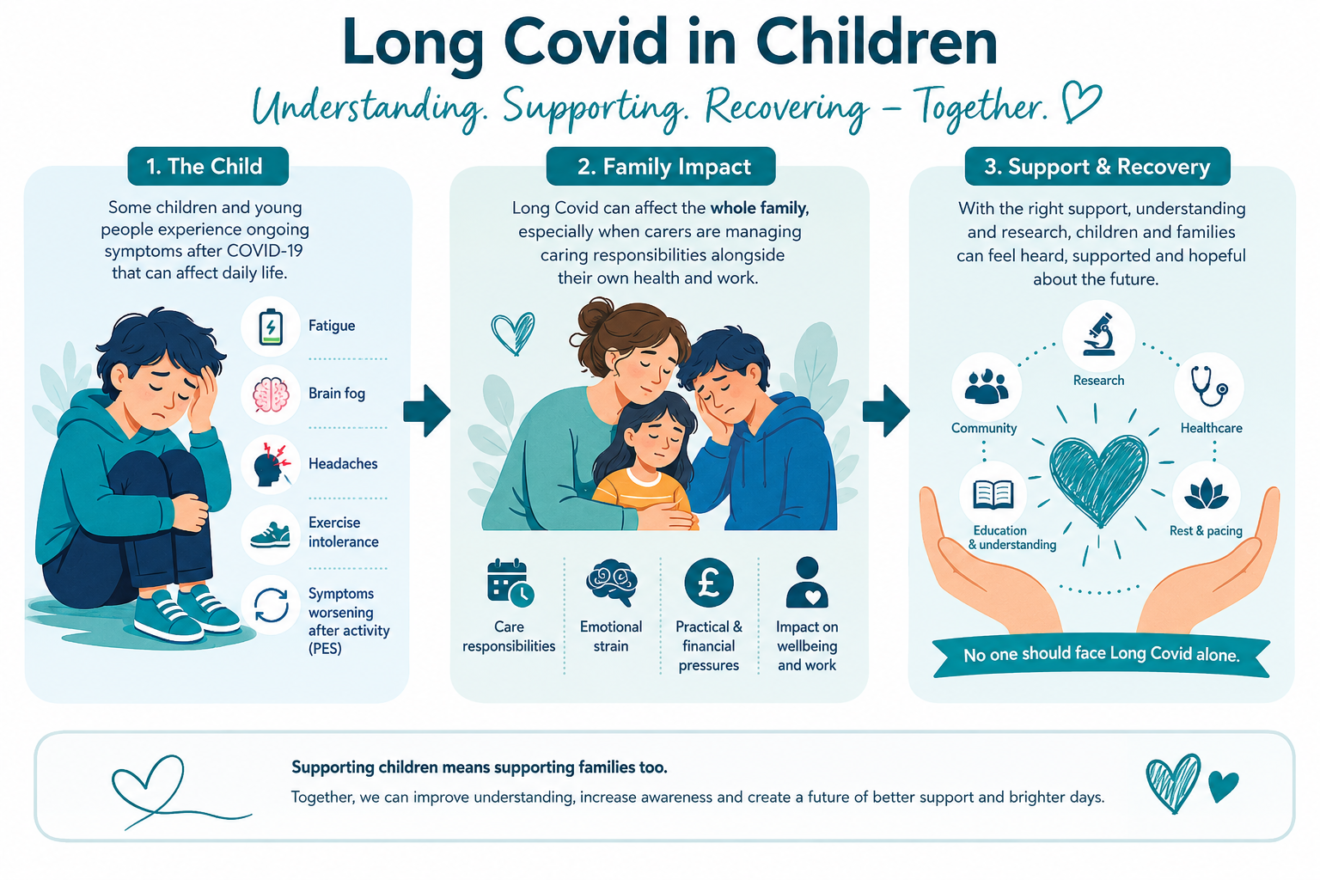
Caring for a child with Long Covid can present unique challenges. Symptoms may fluctuate, school attendance can be affected, and parents and carers often find themselves navigating uncertainty whilst trying to maintain everyday routines.
|
These experiences have helped shape many of the questions researchers are now exploring.
|
This month, we take a closer look at what current research is telling us about Long Covid in children and young people.
|
|
The infographic below highlights some key findings from recent research.
|
|
|
|
|
What Researchers Are Trying to Understand About Long Covid in Children
|
Current research is exploring:
|
- Why some children recover quickly whilst others experience symptoms for months or years.
- Which treatments and support approaches are most effective.
- How Long Covid affects education, family life and long-term wellbeing.
- What factors influence recovery?
While many young people recover fully following COVID-19 infection, some experience ongoing symptoms that can affect daily life, education, wellbeing and recovery over time.
|
- Children may experience Long Covid differently from adults.
- Emerging evidence suggests that symptom patterns, recovery trajectories and educational impacts vary considerably between children, highlighting the need for longer-term follow-up and personalised support.
- Better evidence means better support, better services and better outcomes for children and young people.
|
|
|
🧒 CLoCk Study – The CLoCk Study is one of the largest UK studies examining the long-term effects of COVID-19 in children and young people. Researchers continue to follow participants to understand symptom patterns, quality of life, educational impacts and recovery over time. CLoCk Study
|
🏥 STIMULATE-ICP – Is a major UK research programme designed to improve Long Covid care pathways. The programme is evaluating approaches to diagnosis, treatment and rehabilitation, with the aim of making services more accessible and effective for people living with Long Covid. https://www.stimulate-icp.org
|
|
🌍 WHO Update – The World Health Organization continues to monitor and review evidence on Long Covid in children and adolescents. While many young people recover following COVID-19 infection, some experience ongoing symptoms that can affect daily activities, education and wellbeing. Current research aims to better understand recovery patterns and identify factors associated with prolonged symptoms. https://www.who.int/teams/health-care-readiness/post-covid-19-condition
|
|
|
|
|
|
🩺 Implications for healthcare workers
|
• Symptoms may fluctuate over time, making recovery difficult to predict.
|
• Children and families may require support across healthcare, education and social settings.
|
|
• Understanding the wider impact on family life, education and wellbeing can help inform more holistic care and support.
|
|
|
|
- Better evidence will help improve support, services and outcomes for children and young people living with Long Covid.
|
Interested in learning more about Long Covid in children and young people?
|
Long Covid Kids has developed a short educational video exploring the impact of Long Covid on children and families, and highlighting the importance of awareness, support and safer healthcare environments.
|
|
🎥 Watch: An Introduction to Long Covid in Children here
|
|
|
|
|
Research helps us understand Long Covid.
|
|
Community support & lived experience help us respond to it.
|
|
Here are some ways you can get involved and support others.
|
|
|
What You Can Do
|
🤝 Joining a peer support group
|
|
🔬 Taking part in research
|
|
🌬️ Supporting SafeAir4All
|
|
|
|
|
|
Help Us Improve Safe Air in Healthcare: Our New FOI Project
How seriously is indoor air quality being taken in healthcare settings? We want to find out.
|
As part of our #SafeAir4All campaign, SHH-UK is launching a new Freedom of Information (FOI) project to better understand how NHS organisations are addressing indoor air quality and airborne infection prevention within their infection prevention and control guidance.
|
We know that COVID-19 spreads through the air, yet there is limited publicly available information about how healthcare organisations are monitoring ventilation, using air filtration, displaying CO₂ levels or incorporating safe air principles into routine practice.
|
We will be asking NHS Trusts about:
|
- Indoor air quality within local IPC guidance
- CO₂ monitoring and ventilation assessments
- Air filtration and respiratory protection
- Measures to reduce airborne infection risks for staff and patients
The findings will help identify examples of good practice, highlight areas for improvement and strengthen evidence-based calls for safer healthcare environments.
|
Why this matters
Healthcare workers spend long periods in indoor clinical environments. Understanding how NHS organisations approach ventilation, air filtration and airborne infection prevention can help inform future policy and workplace safety discussions.
|
Get Involved
We are also looking for a volunteer research assistant to help track responses, organise findings and identify key themes.
|
|
Find out more about the #SafeAir4All campaign and how you can support this work.
|
|
|
|
|
|
|
Living with fluctuating symptoms can feel isolating. Our peer support groups provide a space to connect with others navigating similar challenges.
|
|
|

|
|
|
|
|
Upcoming peer support groups
|
Whether you are looking for practical advice, connection or simply a space to talk, we hope one of these groups will be right for you.
|
|
|
|
Peer support groups
SHH-UK peer support groups provide a safe, confidential space for healthcare workers living with long covid to connect, share experiences, and support one another. These groups are peer support and do not replace medical or occupational health advice.
|
All our peer support groups are online and welcoming new members. They are all facilitated by at least 2 SHH-UK volunteers. There's no need to book a place, just come along.
|
|
Please email supportgroup@shh-uk.org if you have any questions, or you would like us to send you a reminder, the day before each peer support group meeting.
|
|
🌙🤝 Evening peer support group
Thursday 4th June at 7:00pm
|
|
This month we'll be sharing our experiences of reasonable adjustments at work.
|
Please note: This peer support group is for healthcare workers, who live with long covid, and are working, or planning a return to work (whether it's the same job, something similar or a completely different job).
|
|
|
|
|
|
🎨🧶 Creative crafts chat
Tuesday 23rd June at 11:00am
|
|
This peer support group meeting is a space for all types of healthcare worker living with long covid (whether you are able to work or not). The focus is creative crafts. Please bring examples of the crafts you are working on and share your experiences of being creative. If you've not explored arts and crafts yet, come along and join the conversation.
|
|
|
|
|
|
🌙🤝 Evening peer support group
Thursday 2nd July at 7:00pm
|
|
This peer support group for healthcare workers who live with long covid and are working, or planning a return to work (whether it's the same job, something similar or a completely different job).
|
|
|
|
|
|
☕💬 Coffee and chat
Tuesday 14th July at 11:00am
|
|
This peer support group meeting doesn't have a formal agenda. It's a space for all types of healthcare workers living with long covid (whether you are able to work or not) to meet, connect and chat.
|
|
|
|
|
💙 Support SHH
Every resource, newsletter, peer support group and campaign is made possible through the support of our volunteers, donors and wider community.
|
- Visiting our online shop
- Making a donation
- Sharing our resources and campaigns
- Encouraging others to join our community
|
|
|
|
|
No One Should Face Long Covid Alone
This month we have explored lived experience, emerging research, patient advocacy and the many ways healthcare workers support one another through the challenges of Long Covid.
|
As always, thank you to everyone who has shared their experiences, contributed content, supported our work, participated in our peer support groups, or helped raise awareness this month. Every story, conversation and contribution helps make a difference.
|
Together, we can continue to learn from one another, support one another, and ensure that no healthcare worker faces Long Covid alone.
|
Thank you for being part of the SHH community.
|
|
|
|
|
|
     
|
|
Some illustrations and infographics in this newsletter were created using AI-assisted design tools and reviewed for accuracy by the SHH team.
|
|
|
|
|
|