

Covid is Airborne: You’re breathing it in
A powerful short video explaining how COVID spreads through the air like smoke, highlighting why ventilation, clean air and respiratory protection matter.
Read more

In this personal account, a healthcare worker with Long Covid describes the frustration ofbeing told to “self-manage” while becoming too unwell to work and struggling to access meaningful medical support.I’m in a position that illustrates the issues not just with Long Covid (LC) but the push to self-care/self-management. In October, I saw a GP as I was unable to drive due to LC, plus I was extremely aware my condition was deteriorating. After a short consultation, she said “we’re here for you, but there’s nothing we can do, you just need to pull yourself together”. She declined to provide a fit note as “it’s up to Occupational Health to decide if you’re fit for work”.
This is the ongoing implementation of self-care/self-management.I’ve been by told a number of GPs to, as one put it, “take responsibility and self-management”. I’ve been told to change my perception of pain, use self-guided Cognitive Behavioural Therapy (CBT), etc. I’m aware – the documentation is public domain – that NHS Grampian strategy is to push self-care as a means of reducing GP appointments, use of outpatient appointments, etc.It’s called supported self-management and described as empowering. The LC clinic team adopt the same approach-self-care, take responsibility, etc.
Now, in my case, I’ve deteriorated to the point where I’ve been sent home from work eight times. The week before last, I managed four hours of a shift. Last week, 10 minutes. That’s experienced and senior nurses saying I’m both unsafe and unwell.
On 26 February 2026 I had a phone assessment with an Occupational Health (OH) consultant. He determined that I was not fit for work for an indefinite period.I had already self-certified illness for seven days.
On 27 February, after management received the Occupational Health report, I was phoned on a rostered day off and instructed not to attend my next two shifts on Monday and Tuesday because the consultant had assessed me as unfit and unsafe to work. I was told I would remain on the rota for the Thursday and Friday shifts pending clarification from HR.
On 3 March I received a further phone call from managers instructing me not to attend the Thursday or Friday shifts either.
At the same time I was asked to provide a GP fit note. My GP has previously declined to provide one on the basis that fitness for work is a matter for Occupational Health. In any case, I had not called in sick. I was instructed by management not to attend work on safety grounds following the Occupational Health determination.
My understanding is that where an employee is instructed not to attend work for safety reasons following an Occupational Health assessment, this would normally be treated as medical suspension with pay maintained under NHS workforce policy.
However, I have been told that because I have not provided a GP fit note my pay will stop immediately and that I will be moved to Stage 3 of the absence management process with a view to termination. This was communicated verbally. Stage 3 is normally described as a supportive stage where options such as redeployment or ill-health retirement are considered, but in my case I have been told these have already been ruled out following the Occupational Health assessment.
The result is a policy contradiction rather than a clinical one.
Occupational Health has determined that I am unfit and unsafe to work, and management has instructed me not to attend the workplace on those grounds. Yet the absence created by that instruction is now being treated as sickness absence requiring a GP fit note. And here’s where it gets even messier. The OH Consultant says “unfit for an indefinite period”. I’m self-managing my condition. At what point do I decide I’ve recovered enough to return? There’s no benchmark for a new baseline, no time frame, nothing.
One thing is for certain, I’m not returning to the GP practice. I have no trust in them whatsoever – for more reasons than above.
It’s a shambles.
More information about Dennis’ Long Covid story can be found here.
A powerful short video explaining how COVID spreads through the air like smoke, highlighting why ventilation, clean air and respiratory protection matter.
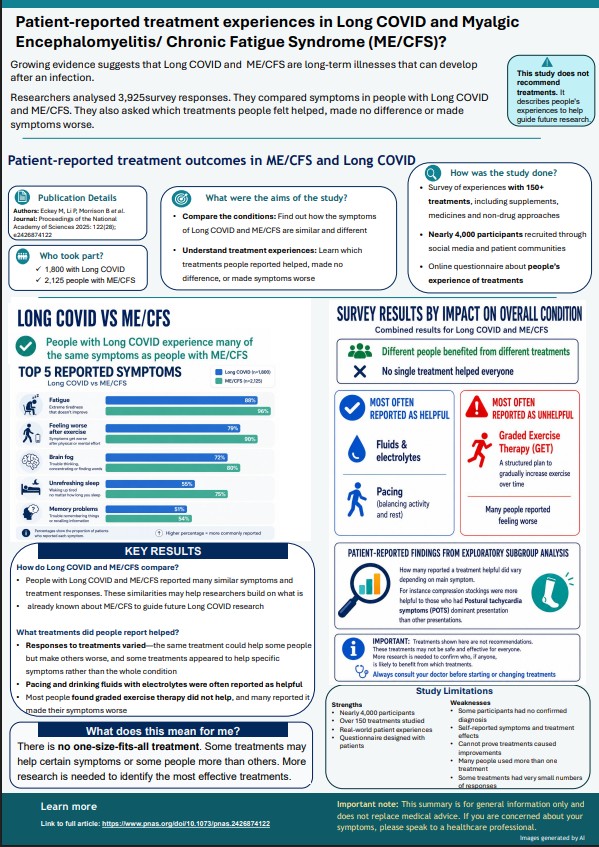
Explore this SHH-UK Research Summary of a study examining patient-reported symptoms and treatment experiences among nearly 4,000 people with Long COVID and ME/CFS.

N95 and KN95 respirators may look similar, but they are certified to different national standards. Both are designed to provide a high level of filtration, with each rated to filter at least 95% of specified test particles. (Smart Air)