
How Airborne Transmission Works
Discover how airborne infections spread and why ventilation, air filtration and respiratory protection are vital to protecting healthcare workers.
Read more

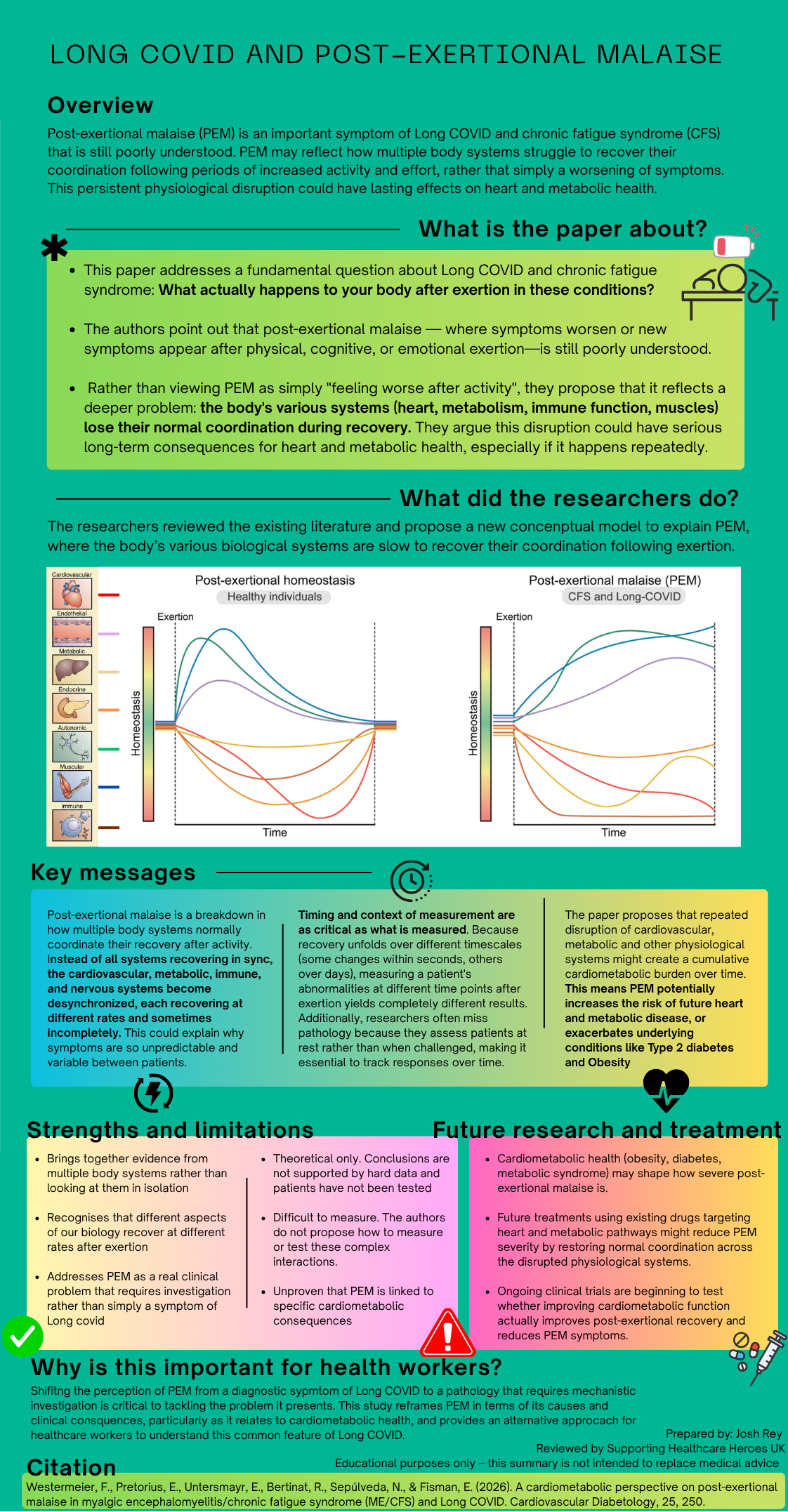
Post-exertional malaise (PEM) can cause symptoms to worsen after physical, cognitive or emotional activity. This infographic summarises a 2026 paper proposing that, in Long Covid and ME/CFS, different body systems may recover at different rates after exertion. The model is theoretical and needs further testing.
This infographic summarises a 2026 paper on post-exertional malaise (PEM) in Long Covid and ME/CFS. It was prepared by Josh Rey, SHH-UK Research Summary Volunteer, for Supporting Healthcare Heroes UK.

About post-exertional malaise: The authors review existing research and propose a conceptual model in which different body systems may recover at different rates after exertion. This is a theoretical model; further research is needed to test it and clarify its clinical implications.
Westermeier F, Pretorius E, Untersmayr E, et al. (2026). A cardiometabolic perspective on post-exertional malaise in myalgic encephalomyelitis/chronic fatigue syndrome (ME/CFS) and Long COVID. Cardiovascular Diabetology, 25, 250. About the paper on post-exertional malaise.
Discover how airborne infections spread and why ventilation, air filtration and respiratory protection are vital to protecting healthcare workers.

A large study of adults in England found that unresolved Long COVID was associated with lower odds of remaining in paid work and higher odds of changing working hours. The impact differed across symptom profiles.

xplore 12 findings from Germany’s Long Covid guidance, including PEM, cognitive dysfunction, POTS and implications for UK healthcare workers.