

Covid is Airborne: You’re breathing it in
A powerful short video explaining how COVID spreads through the air like smoke, highlighting why ventilation, clean air and respiratory protection matter.
Read more

Summary
NHS staff with Long Covid face barriers returning to work; urgent support, flexibility, and funding are needed.
Today I attended, nearly three years into my Long Covid journey, a workshop run by my local Long Covid clinic and the Richmond Fellowship on employment. One of the key messages was that it is possible for people to return to work with Long Covid but that this needs creativity.
After attending the workshop, I went onto Facebook only to find yet another NHS worker with Long Covid has been dismissed because they can’t say when they will be back at work. Last week I posted on Twitter stating:
In the past few days numerous NHS staff with #LongCovid have posted on Facebook saying HR are preventing their return to work by insisting they can only have a 4-6 week phased return at 50% of their normal hours. This is setting people up to fail and goes against all the best practice guidelines. Anyone would think we didn’t have a workforce crisis let alone a moral obligation to support our staff. #NHSHeroToZero
I can’t see any creativity here. At a time when there is an NHS workforce crisis this is CRAZY and incredibly short-sighted. I also consider this IMMORAL, particularly as many NHS employers chose to follow inaccurate Government guidance rather than adhere to their requirements under Health and Safety legislation (see this blog). (A summary of the evidence that Covid is Airborne can be found by clicking here.)
Workers with Long Covid have told us about enablers which support them to return to work. Several research studies also provide information about these enablers (e.g., Lunt et al. 2022) as well as the impact of Long Covid on people’s ability to work (Figure 2). (This is discussed in more detail in a recent editorial.) A recent study also found that returning to work after Long Covid took significantly longer than after the flu with 5.5% of employees who caught covid being off work for more than 12 weeks (Aben et al. 2023).
Details of enablers for returning to work (courtesy of Long Covid Work) can be seen below.
A summary regarding the impact of Long Covid on employment can be seen below.
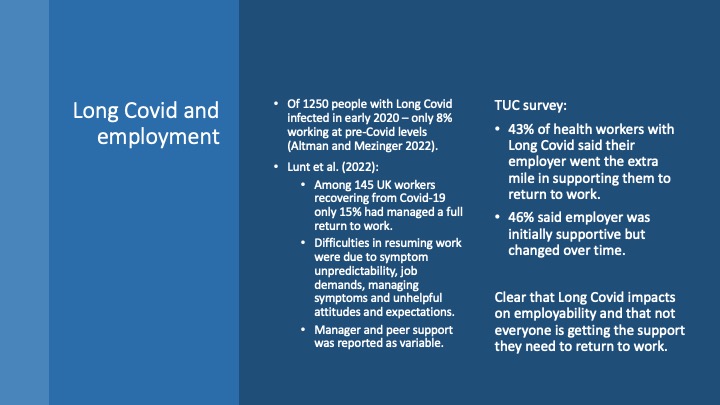
(Medinger, G. and Altman, D. (2022) The Long Covid Handbook, Penguin Books: Dublin; Lunt et al. 2022; TUC survey) (Since this blog was published there is much more evidence relating to the impact of Long Covid on someone’s ability to work.)
Despite the availability of evidence about how to support people back to work (Box 1) many NHS staff with Long Covid continue not to receive the support they need to do so. Some examples of having to fight for reasonable adjustments are provided below.

In addition some employers do not seem to be meeting the requirements of the 2010 Equality Act. (More information about whether Long Covid is a disability can be seen here.)
Best practice guidelines
Royal College of Nursing best practice guidelines on supporting a staff member back to work provided by the can be found by clicking here.
Information and advice from the Society of Occupational Medicine can be accessed by clicking here.
UNISON has published Bargaining guidance on supporting members with long COVID or post-COVID-19 syndrome
If the NHS cares about its workers with Long Covid (and I sometimes doubt they do) NOW is the time for action. Unions and NHS employers need to lobby the UK Government for money to support the return to work of staff with Long Covid as part of a long-term sustainable workforce plan. The funding received could be used to, among other things:
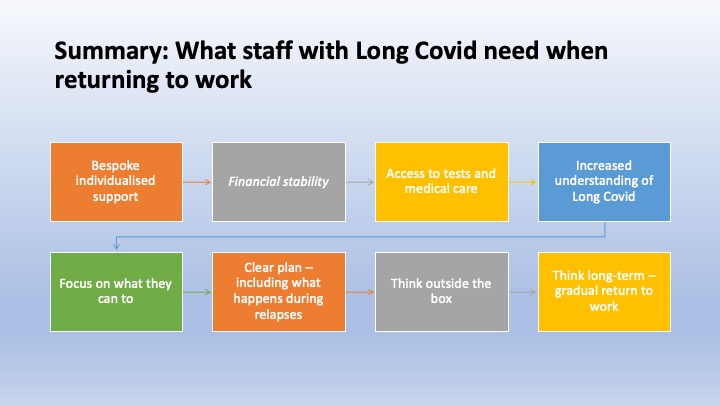
A summary of the support NHS staff with Long Covid need when returning to work can be seen below. There are currently so many vacancies in the NHS I believe that with a degree of creativity, it should be possible to create roles that enable staff with Long Covid to return to work (even if this is from home) while relieving the pressure on others. Thus keeping staff in the NHS workforce for the future. Surely, it’s a no brainer?
A powerful short video explaining how COVID spreads through the air like smoke, highlighting why ventilation, clean air and respiratory protection matter.
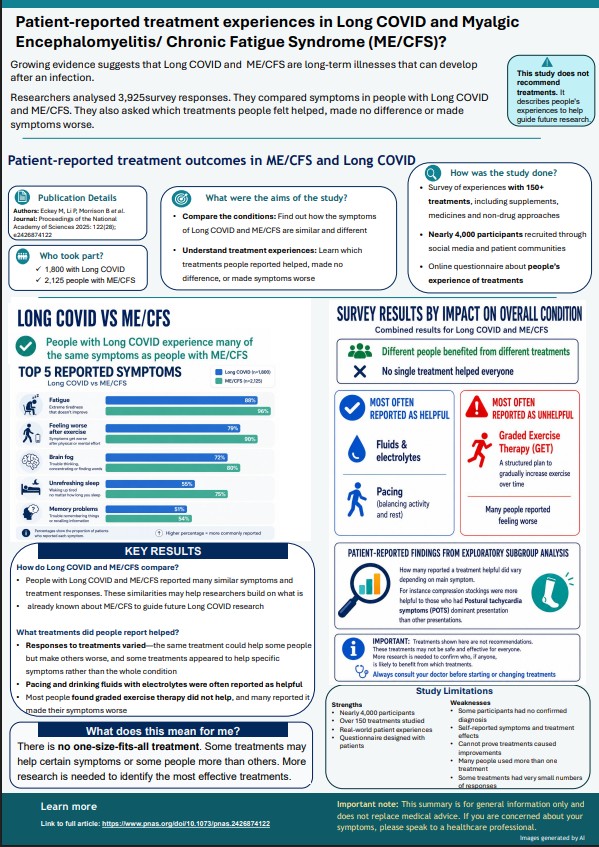
Explore this SHH-UK Research Summary of a study examining patient-reported symptoms and treatment experiences among nearly 4,000 people with Long COVID and ME/CFS.

N95 and KN95 respirators may look similar, but they are certified to different national standards. Both are designed to provide a high level of filtration, with each rated to filter at least 95% of specified test particles. (Smart Air)