

Covid is Airborne: You’re breathing it in
A powerful short video explaining how COVID spreads through the air like smoke, highlighting why ventilation, clean air and respiratory protection matter.
Read more

Summary:
Long Covid patients and healthcare providers share their views on testing and treatment, interactions and resources.
Turk, F. et. al. (2024) summarised by Rachael McGill
Introduction
Part of the national Delphi study on Long Covid, this project recruited eight people with Long Covid from different locations and with different symptoms, as well as eight healthcare practitioners working in different settings. Participants were interviewed via telephone or video call and asked about what created barriers to care, and what helped with access to care for people with Long Covid. The aim was to increase understanding of the nature of these barriers and how patient experiences varied.
Summary
Three themes were identified: (1) patients’ efforts to navigate new and changing routes to diagnosis, testing and treatment for Long Covid, (2) the patient–healthcare practitioners interaction and (3) resources and structural constraints. The perspectives of patients and healthcare practitioners were similar.
In navigating routes to care, the main barriers were unmanaged online resources and GPs being overwhelmed. What helped was engagement with online communities and the patient taking an active role in their healthcare by pushing GPs and specialists for tests, treatment and referrals. People with Long Covid emphasised the huge efforts they needed to make in negotiating and accessing what they felt was appropriate care.
Barriers related to the patient–healthcare practitioner interaction were the limited knowledge about Long Covid and an unresponsive approach from doctors. What helped was a collaborative and patient‐centred approach; continuity of care and trust between patients and healthcare practitioners; plus GPs having prior knowledge of patients and being open‐minded and willing to help. Both patients with Long Covid and healthcare practitioners emphasised the importance of building a trusting and collaborative relationship.
In terms of resources and structural constraints, barriers included oversubscribed GPs; lack of variety in appointments (remote, in person); long waiting times for specialists and lack of communication across services. What helped was electronic booking and reminder systems; alternative ways of making contact; signposting to self‐management services while waiting for referrals and a single point of access for prioritising referrals. Patients and agreed that waiting times for specialists are excessively long and alternative methods of contact are helpful. However, while some healthcare practitioners mentioned signposting self‐management services during the waiting period for referrals, none of the patient participants mentioned being offered such services.
Conclusion
Despite these interviews being conducted two years after the start of the COVID‐19 pandemic, There was still a need for people living with Long Covid to be believed by the practitioners they encounter. People with Long Covid often encountered obstacles in obtaining the expected level of care or, in some cases, did not receive it at all. Policy makers should consider improving integrated healthcare systems to reduce waiting lists, enhancing continuity of care and improving communication across different care settings. Healthcare practitioners would benefit from collaborating with their patients, providing evidence‐based online resources and demonstrating reassurance. Patients and healthcare practitioners agreed that trust, empathy and clear communication are essential. Further research is needed with a larger number of Long Covid patients and healthcare providers to gain a clearer understanding.
Read the study here
A powerful short video explaining how COVID spreads through the air like smoke, highlighting why ventilation, clean air and respiratory protection matter.
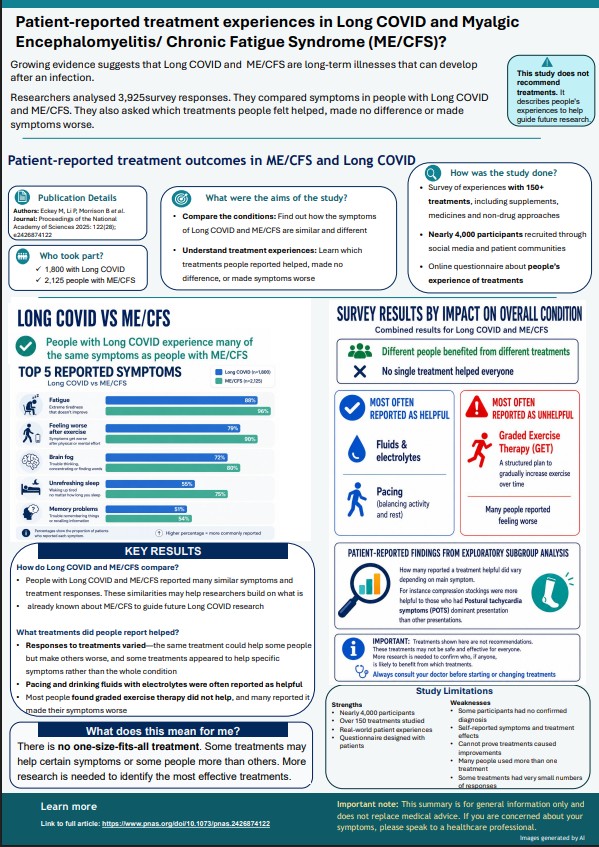
Explore this SHH-UK Research Summary of a study examining patient-reported symptoms and treatment experiences among nearly 4,000 people with Long COVID and ME/CFS.

N95 and KN95 respirators may look similar, but they are certified to different national standards. Both are designed to provide a high level of filtration, with each rated to filter at least 95% of specified test particles. (Smart Air)