This is the third of three blogs by one of our supporters Dr Jenny Ceolta Smith. In part 3 she writes about my lessons learnt while advocating and share my personal insights into what might support our health and wellbeing while advocating.
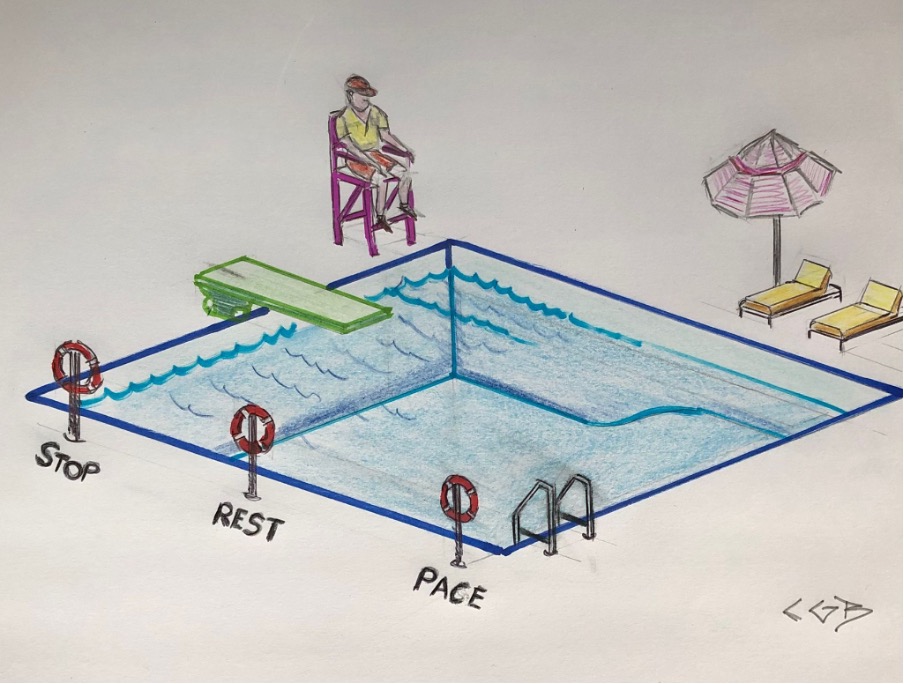
Drawing by @ColinGBarrow
Laying out by the side of the pool: lessons learnt:
I’m far from being an expert advocate and I don’t always do the right things in terms of what’s best for my health. I’ve overridden the warning triggers and am often trying to save myself from drowning. But this year in 2024, I have been much stricter in weighing up whether to take on an advocacy task or not.
Advocacy isn’t necessarily cost free, and the financial costs can add up and often go unnoticed by stakeholders including collaborations with allies. Costs include things like printing ink, paper, software, phone calls and perhaps also in some cases travel.
Ten key questions you may want to consider before embarking on advocacy and not just diving in:
- How is your health right now?
- Do you have the energy required to undertake advocacy?
- Want form of advocacy do you want to undertake (on your own or with others)?
- Do you need any support e.g. accommodations to undertake tasks?
- Think about your lifebuoy safety rings: Stop Pace and Rest. So, think about planning, pacing, prioritising and whether you will have any ways to delegate tasks. For example, this may be considering the times you have to carry out any advocacy, per day, per week, per month.
- Can you dip your toe in, or shadow an experienced advocate and see what might be good options for you?
- Are there any options to buddy up with another advocate or a Long Covid group or charity?
- Swimming alone- sometimes advocacy can be emotionally difficult, so who might you turn to if you need to debrief?
- Closing the pool – What steps can you take to set and stick to some boundaries of advocacy engagement? (e.g. such as controlling social media use, emails, media requests, online meetings, or phone calls)
- Who will watch out for you, be your lifeguard and spot any signs if your health and wellbeing is deteriorating through doing too much advocacy?
I’m leaving out a discussion on what people commonly refer to as “advocacy burnout”, that’s for another day. But in my experience advocacy needs can often feel relentless and it’s hard not to be reactive to all the harms we want to address. So, adopting the ethos of Stronger Together and being strategically aligned with as many Long Covid and MECFS groups and allies as possible feels like the only sustainable way forward.
In part 2 I shared the link to my open letter to the Royal College of Occupational Therapists (RCOT). I appreciated the opportunity to meet with RCOT recently and will be keeping in touch with their policy department about the matters I raised.
My top three tips for protecting your time and supporting your health and wellbeing while advocating:
- Try short, focused meetings for one key task and set different arrangements for other agenda points, tasks and mini catchups about how everyone is doing.
- Consider drawing up an advocacy wellness plan to spot any warning signs or triggers that you are taking on too much advocacy, e.g. to spot when tasks are impacting on your symptoms, wellbeing or close relationships.
- Ask journalists if they will accept a quote for a news media piece rather than arranging to interview you as that takes considerable energy, and they don’t often use most of what you say. I ask journalists to email back any quotes they want to use from an interview so I can check I’m comfortable with them too. I don’t invest heavily in advance preparation for journalists anymore as some can let you down and not get back to you.
Here are three examples of being quoted in the media by considerate journalists when advocating on employment issues, benefits and Long Covid rehabilitation.
A final word to stakeholders (including our allies) who may ask or expect Long Covid advocates to just do or pitch in:
Please remember when asking us to support a task that we are ill, and our symptoms may be invisible to you. We may need accommodations. Think ahead about how you will acknowledge all that we have given to a task. Remember we may not have an income or may be receiving benefits and find it difficult to ask for some form of reimbursement of any associated costs.
You may want to acknowledge our contribution in some way, for example, offer an honorarium, cover any expenses, name, and credit us on related documents, or perhaps even come up with something novel. It is wise to agree any such acknowledgments (e.g. co authorship or cited as a patient/lived experience reviewer and how written work is to be cited) in advance rather than having potentially awkward conversations once a task is completed. Importantly if you offer these things above and an advocate has only fulfilled part of what has been agreed, please don’t ignore their contribution.
Signing off, saving myself from drowning – so ready for my advocacy pause…
It’s been hard to step back from advocating ahead of my pause and not contributing to the recent Department for Work and Pensions written submissions by Long Covid Support e.g. on the consultation for Personal Independence Payment and the fit note. But…
“After four plus years I’ve learnt that it is ok to switch track and advocate with different people and groups, to stop advocating activities if they no longer feel good for my health or wellbeing, to say no to requests, to ask for more time or support, or pass a task onto someone else. And if there’s no one who is well enough to take on a task then, it’s ok to let it go, to step back and take a pause to save myself from drowning…”
Open advocacy roles include being a Long Covid Support Advisor and supporting tasks related to employment and benefits with my peers, ongoing member of the Society of Occupational Medicine Task force previously for Long Covid and now expanded for longer-term conditions.
Find me when I’m there at: X formerly Twitter: @JCeoltaSmith and @WorkingWithLC @jceoltasmith.bsky.social
I couldn’t include all the advocacy outputs, co-produced and or supported with my peers in part 1,2 &3 so I have listed some more here:
A guide to claiming Personal Independence Payment that I wrote with support from GMLaw’s welfare Rights Expert Dan Manville and peer reviewed by my occupational therapy peer Laura Maloney.
Return to work podcasts:
Gez Medinger: How to Go Back to Work – and When? | Long Covid
Support After Covid – Study Podcast Series:
Support After COVID-19: A series of podcasts focusing on the challenges of Long Covid and employment. Organised by Professor Cathy Bulley and Dr Eleanor Curnow, Queen Margaret University. Featuring Dr Linda Renton, Dr Jenny Ceolta-Smith and Ms Kirsty Stanley
Publications:
Abandoned by governments and employers co-authors Dr Alison Twycross and Dr Clare Rayner
Post COVID-19 recovery personalised care Moses et al. (2022)
Webinars presentation:
Long Covid Support, NIHR and Long Covid Scotland where I presented on the joint TUC and Long Covid Support survey and financial impacts.
Documents reviewed and or contributed to:
CIPD research: Working with Long Covid research to inform support Feb 2022
The Society of Occupational Medicine; Long Covid a Guide for managers April 2024:
What Are Energy Limiting Conditions? Produced for Astriid. Author Catherine Hale
Acknowledgements and thanks to:
My advocacy peer and friend Dr Clare Rayner for reviewing an earlier draft of this blog.
Colin Barrow for the poolside drawing.
To all my peers with Long Covid who I have collaborated with since 2020, this includes so many people who have shared their experiences with me and given consent to draw on these for our advocacy. To our wonderful allies and especially our advocates within Long Covid charities and groups including Long Covid Support, Long Covid SOS, Long Covid Physio, ME Local Network, Supporting Healthcare Heroes UK, Long Covid Nurses and Midwives, Key Workers Petition UK, Chronic Illness Inclusion, Long Covid Kids, PossAbility: ME, Long COVID & Work. To those I have advocated closely since 2020: Clare Rayner, Polina Sparks, Kirsty Stanley, Lesley Macniven, Sophie Evans, Cathy Thomson, Karen Cook, Joanna Clynes, Helen Skiffington, Laura Maloney, Alison Twycross, Catherine Hale, Louise Beaton, Linda Hending, Leslie Cohen, Laura Witcomb and Sue Birch. There are many more people who have been and continue to be part of my advocacy journey some who are behind the scenes so please forgive me for not listing everyone here.