Persistent Long COVID symptoms in healthcare personnel
Category
Research summaries
Share
Weekly Research Summary
This week’s SHH-UK research summary examines persistent Long COVID symptoms in healthcare personnel. The US study followed symptomatic healthcare personnel after COVID-19 and recorded symptoms approximately three and six months later.
Among 1,496 participants who completed both follow-up surveys, 11.3% reported the same moderate or severe symptom at both timepoints. This was an observational study, so the findings show associations and do not prove cause and effect.
Scroll through the visual summary below, or continue to the accessible text version.
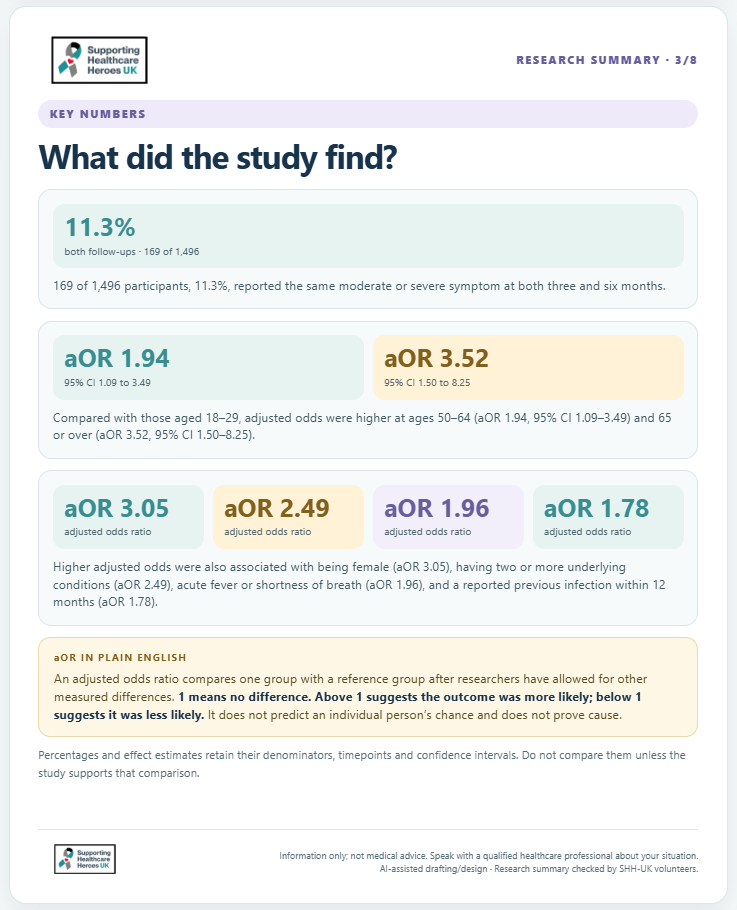
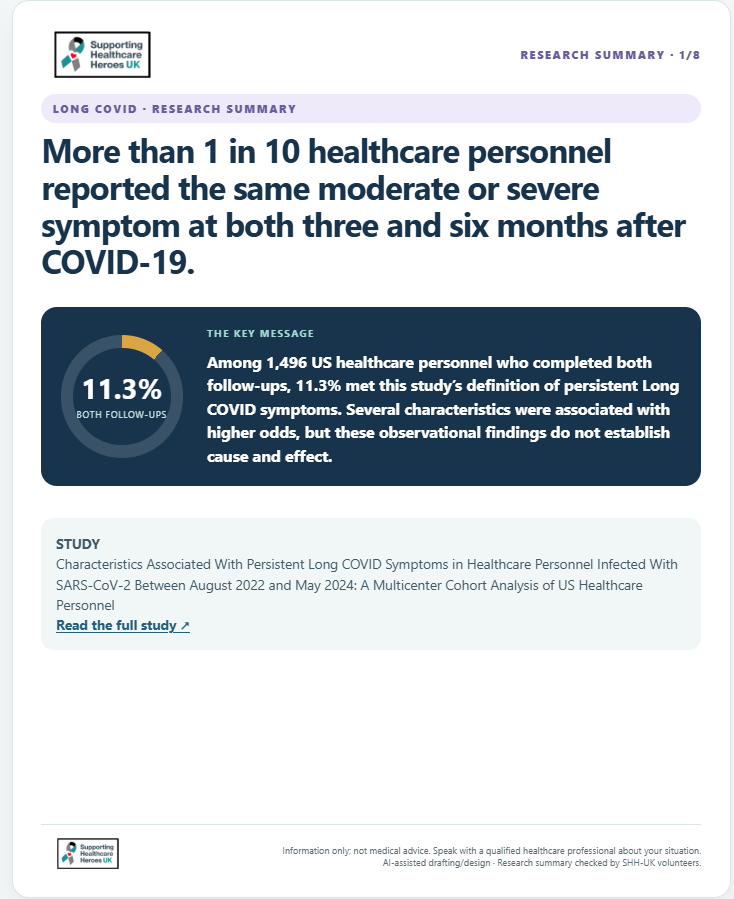
Among 1,496 US healthcare personnel who completed both follow-up surveys, 169 people (11.3%) met this study’s definition of persistent Long COVID symptoms.
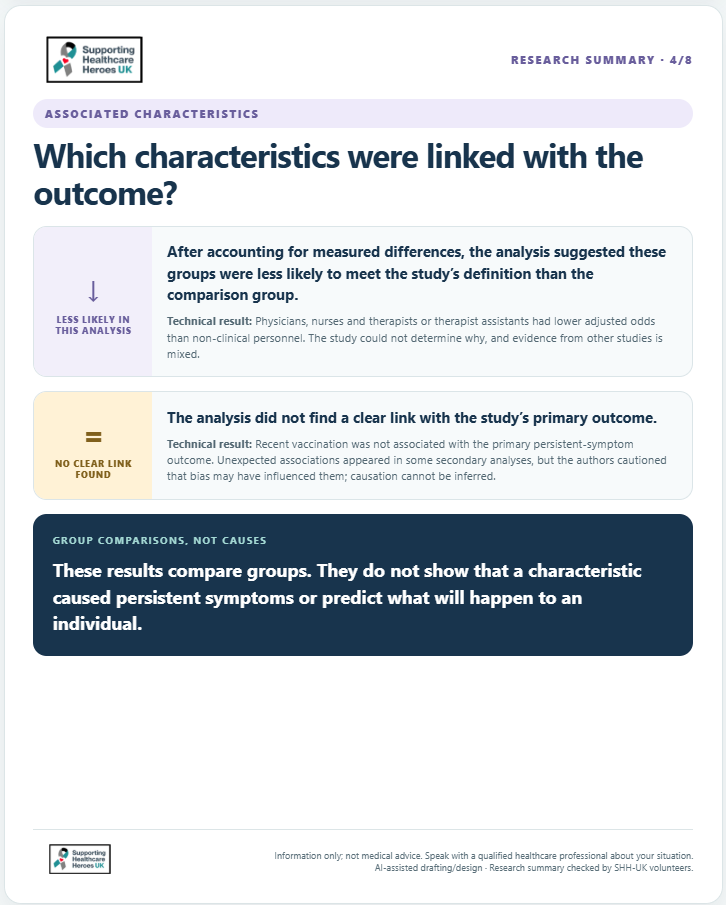
Several personal and health characteristics were associated with a greater likelihood of persistent symptoms. However, this was an observational study. It identified patterns but could not show that any characteristic caused persistent symptoms.
STUDY TITLE
Characteristics Associated With Persistent Long COVID Symptoms in Healthcare Personnel Infected With SARS-CoV-2 Between August 2022 and May 2024: A Multicenter Cohort Analysis of US Healthcare Personnel.
STUDY DESIGN AND SETTING
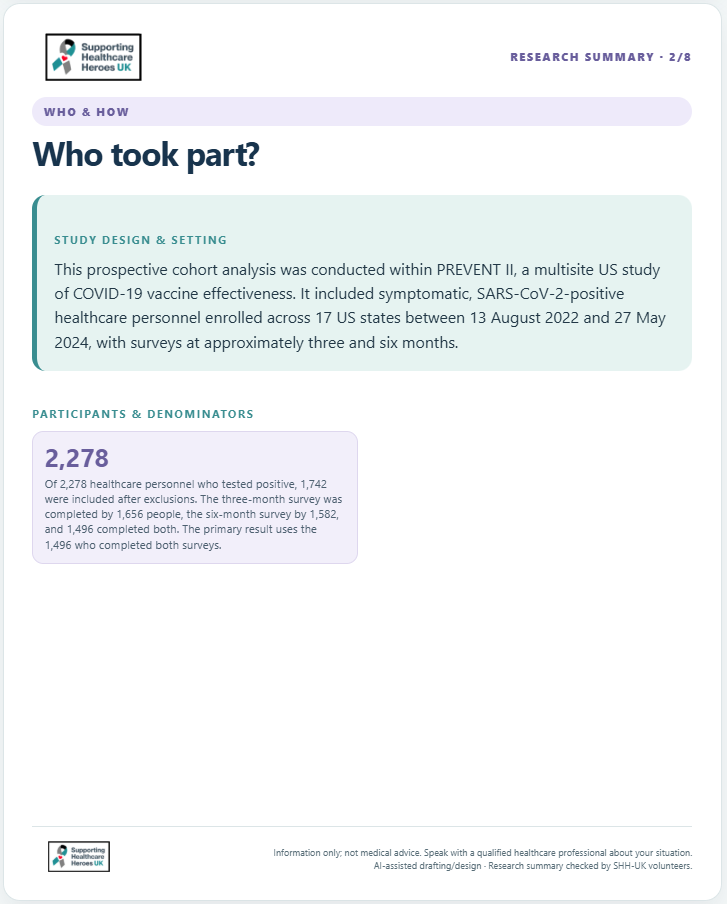
This prospective cohort analysis was conducted within PREVENT II, a multisite US study of COVID-19 vaccine effectiveness.
The analysis included symptomatic healthcare personnel who tested positive for SARS-CoV-2. They were enrolled across 17 US states between 13 August 2022 and 27 May 2024.
Participants completed surveys when they joined the study and approximately three and six months after infection.
WHO TOOK PART?
2,278 healthcare personnel tested positive when they joined the study.
After exclusions, 1,742 people were included in the analysis.
1,656 people completed the three-month survey.
1,582 people completed the six-month survey.
1,496 people completed both surveys and contributed to the main persistent-symptom analysis.
HOW DID THE STUDY DEFINE PERSISTENT SYMPTOMS?
For this study, persistent Long COVID symptoms meant that a participant reported the same moderate or severe symptom at both the three-month and six-month surveys.
This was a study-specific definition. It was not the same as receiving a clinical diagnosis of Long COVID.
WHAT DID THE STUDY FIND?
Of the 1,496 participants who completed both surveys, 169 people (11.3%) reported the same moderate or severe symptom at both three and six months.
At three months, 320 of 1,656 participants (19.3%) reported at least one moderate or severe symptom.
At six months, 435 of 1,582 participants (27.5%) reported at least one moderate or severe symptom.
The three-month and six-month percentages came from different numbers of respondents. They should not automatically be interpreted as showing that symptoms increased over time.
Fatigue was the most frequently reported symptom at both follow-ups:
At three months, 132 of 1,656 participants (7.97%) reported fatigue.
At six months, 168 of 1,582 participants (10.62%) reported fatigue
WHICH CHARACTERISTICS WERE ASSOCIATED WITH PERSISTENT SYMPTOMS?
After accounting for other measured differences between participants, a greater likelihood of persistent symptoms was associated with:
Being aged 50 to 64, compared with being aged 18 to 29
Being aged 65 or over, compared with being aged 18 to 29
Being female, compared with being male
Having two or more underlying health conditions
Reporting fever or shortness of breath during the acute illness
Reporting a previous SARS-CoV-2 infection within the preceding 12 months
The study also found that physicians, licensed practical and registered nurses, and therapists or therapist assistants had a lower likelihood of the study outcome than non-clinical healthcare personnel.
This does not mean that people working in those occupations were protected from Long COVID. The study could not determine why the occupational differences occurred, and findings from other studies have been mixed.
WHAT DID THE STUDY FIND ABOUT RECENT VACCINATION?
Recent vaccination was not associated with the study’s main persistent-symptom outcome.
Some secondary analyses found a greater likelihood of symptoms among recently vaccinated participants. The authors described these findings as unexpected and cautioned that selection bias or misclassification may have influenced them.
These observational findings do not show that vaccination caused persistent symptoms. The parent study was not designed to determine whether vaccination caused or prevented Long COVID over an extended follow-up period.
WHY DOES THIS MATTER FOR SHH-UK READERS?
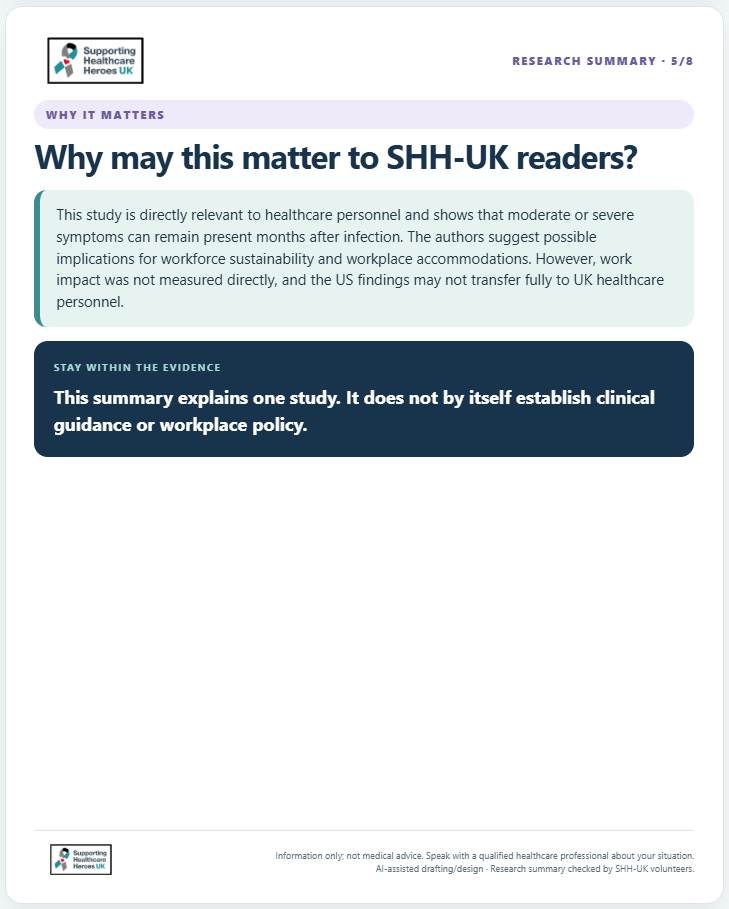
The study shows that moderate or severe symptoms can remain present for months after COVID-19 among people working in healthcare.
The authors suggested that persistent symptoms could affect the sustainability of the healthcare workforce. Some affected workers may need workplace adjustments, reduced hours, modified schedules or changes to their roles.
However, the study did not directly measure:
Work performance
Sickness absence
Return to work
The use or effectiveness of workplace support
The study was conducted in the US, so its findings may not apply directly to healthcare personnel working in the UK.
LIMITATIONS AND UNCERTAINTY
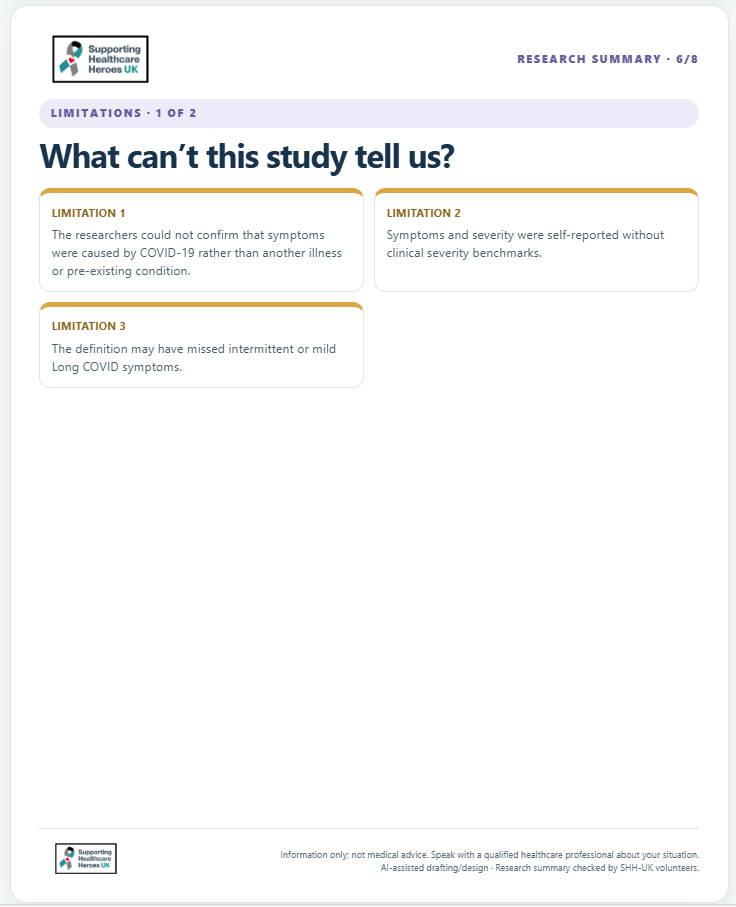
The researchers could not determine whether symptoms reported at three and six months were caused directly by COVID-19. Other illnesses or pre-existing conditions may have contributed.
Participants reported their own symptoms and symptom severity. The study did not use clinical benchmarks to determine what counted as moderate or severe.
Requiring the same symptom to be present at both follow-ups may have missed people whose Long COVID symptoms were intermittent or changed over time.
Excluding mild symptoms may have underestimated the number of people experiencing ongoing symptoms.
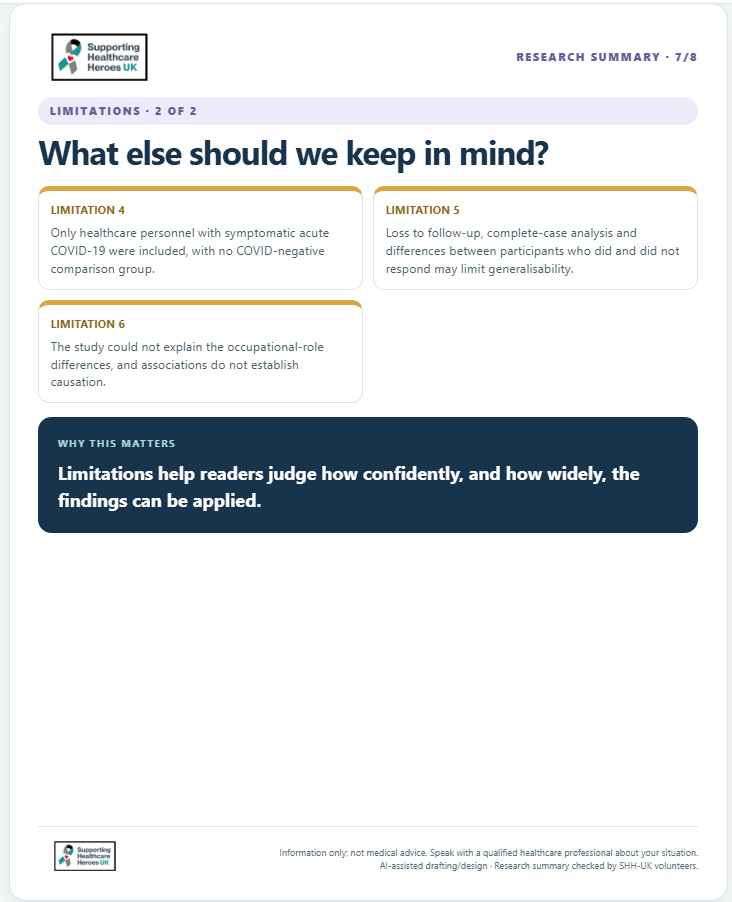
The study included only healthcare personnel who had symptomatic acute COVID-19.
There was no COVID-negative comparison group.
Previous infections were self-reported.
Some additional infections occurring during the follow-up period could not be assessed.
Differences between people who completed the follow-up surveys and those who did not may limit how widely the findings can be generalised.
The complete-case analysis excluded participants with missing demographic information, although only ten people were excluded for this reason.
GLOSSARY
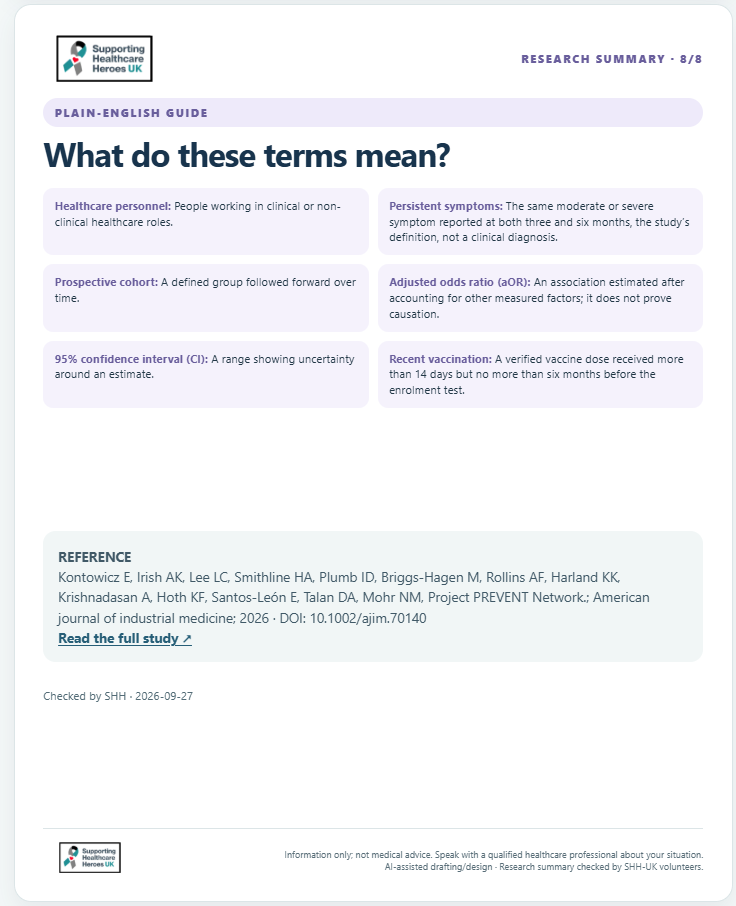
Healthcare personnel
People working in healthcare in clinical or non-clinical roles.
Persistent Long COVID symptoms
In this study, the same moderate or severe symptom reported at both the three-month and six-month surveys. This was a study-specific definition, not a clinical diagnosis.
Prospective cohort analysis
A study that follows a defined group of people forward over time and records what happens to them.
Adjusted odds ratio
A comparison of how likely an outcome was between groups after allowing for other measured differences.
A value above 1 means the outcome was more likely in the group being examined. A value below 1 means it was less likely. It does not tell us exactly how many people were affected and does not prove that one factor caused the outcome.
95% confidence interval
A range showing the uncertainty around an estimate. A wider range means there is more uncertainty about the exact result.
Recent vaccination
A verified vaccine dose received more than 14 days but no more than six months before the participant’s enrolment test.
STUDT DETAILS
AUTHORS: Kontowicz E, Irish AK, Lee LC, Smithline HA, Plumb ID, Briggs-Hagen M, Rollins AF, Harland KK, Krishnadasan A, Hoth KF, Santos-León E, Talan DA, Mohr NM, Project PREVENT Network.
STUDY TITILE: Characteristics Associated With Persistent Long COVID Symptoms in Healthcare Personnel Infected With SARS-CoV-2 Between August 2022 and May 2024: A Multicenter Cohort Analysis of US Healthcare Personnel.”
JOURNAL: American Journal of Industrial Medicine. 2026.
This summary is provided for information only and is not medical advice. It does not replace the complete research paper or advice from a qualified healthcare professional.
AI-assisted drafting and design were used to prepare this summary. The source and final content were checked by an SHH-UK human reviewer before publication.