
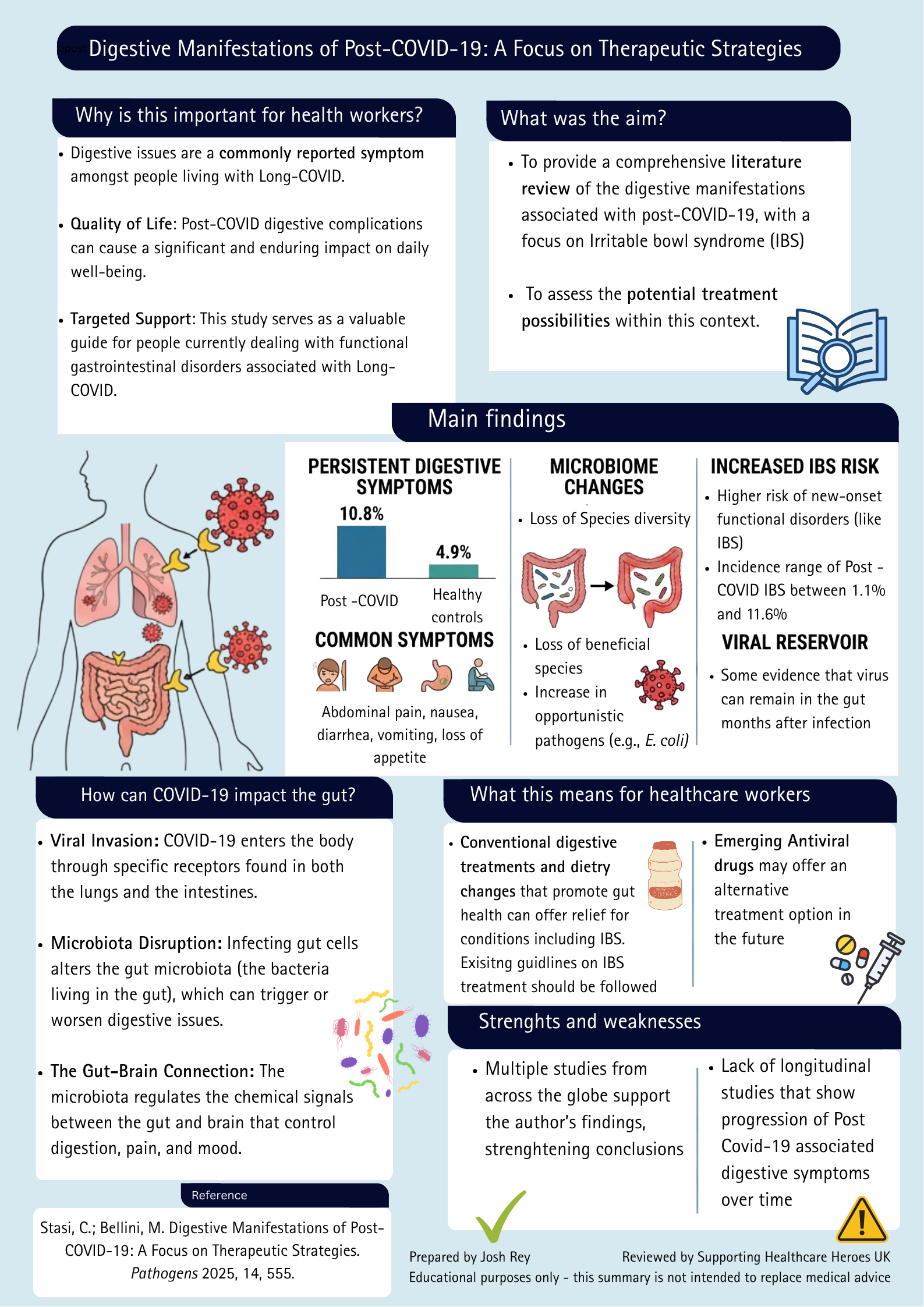
Long COVID and Digestive Symptoms: What the Research Tells Us
Research summary exploring digestive manifestations of Long COVID, including gut microbiome changes, IBS risk and potential treatment approaches.
Read more

Summary: A retrospective hospital study found that reducing routine PPE to N95 respirators was not linked to higher staff COVID-19 rates and reduced environmental impact.
Study by Sutjipto S et al (2025), summarised by Hannah Bissell
Introduction
During the COVID-19 pandemic, the World Health Organization issued guidance for healthcare workers caring for patients with COVID-19. This included the use of Personal Protective Equipment such as gowns, face shields, gloves, medical masks, and respirators during certain procedures. In 2023, the World Health Organization declared the pandemic phase over and recommended a shift from emergency responses to standard infectious disease management. However, many national Personal Protective Equipment guidelines remained largely unchanged.
Singapore was an early adopter of updated guidance. In September 2022, the Singapore Ministry of Health revised Personal Protective Equipment recommendations for healthcare workers caring for suspected or confirmed COVID-19 patients, advising the use of N95 respirators alone for routine care. This study aimed to assess whether reducing Personal Protective Equipment use affected COVID-19 infection rates among hospital staff, while also examining the environmental impact of reduced Personal Protective Equipment use.
Summary
This retrospective study was conducted in Singapore using data from Tan Tock Seng Hospital and the National Centre for Infectious Diseases. Researchers examined COVID-19 infection rates among healthcare workers over two periods: before Personal Protective Equipment de-escalation (October 2021 to September 2022) and after Personal Protective Equipment de-escalation (October 2022 to September 2023).
COVID-19 infection trends among hospital staff reflected wider community trends, including pandemic surges. Importantly, reducing Personal Protective Equipment use was not associated with an increase in COVID-19 infections among healthcare workers. Staff infection rates continued to closely follow community infection rates, suggesting that most infections were driven by community exposure rather than workplace transmission.
The environmental benefits were substantial. On average, four disposable gowns were saved per patient-day. Over a 12-month period, this resulted in more than 440,000 fewer gowns used, leading to significant reductions in carbon emissions, plastic waste, and healthcare costs.
Conclusion
The study found that updated Singapore Personal Protective Equipment guidelines, limiting routine COVID-19 care to the use of N95 respirators alone, were effective at protecting healthcare workers from COVID-19 while also benefiting the environment.
These findings are supported by a recent systematic review, which brings together the most up-to-date evidence, and found that N95 respirators are effective at protecting healthcare workers from COVID-19, while the additional protective benefit of gloves, gowns, and face shields is less clear.
A key limitation of the study was potential underreporting of COVID-19 infections among hospital staff, as compulsory testing ended in March 2022.
Overall, the study demonstrates that national Personal Protective Equipment de-escalation guidelines were associated with reduced gown use, lower costs, and meaningful reductions in carbon footprint and plastic waste, without any clear compromise to healthcare worker safety.
Article link- https://doi.org/10.1001/jamanetworkopen.2025.5264
Research summary exploring digestive manifestations of Long COVID, including gut microbiome changes, IBS risk and potential treatment approaches.
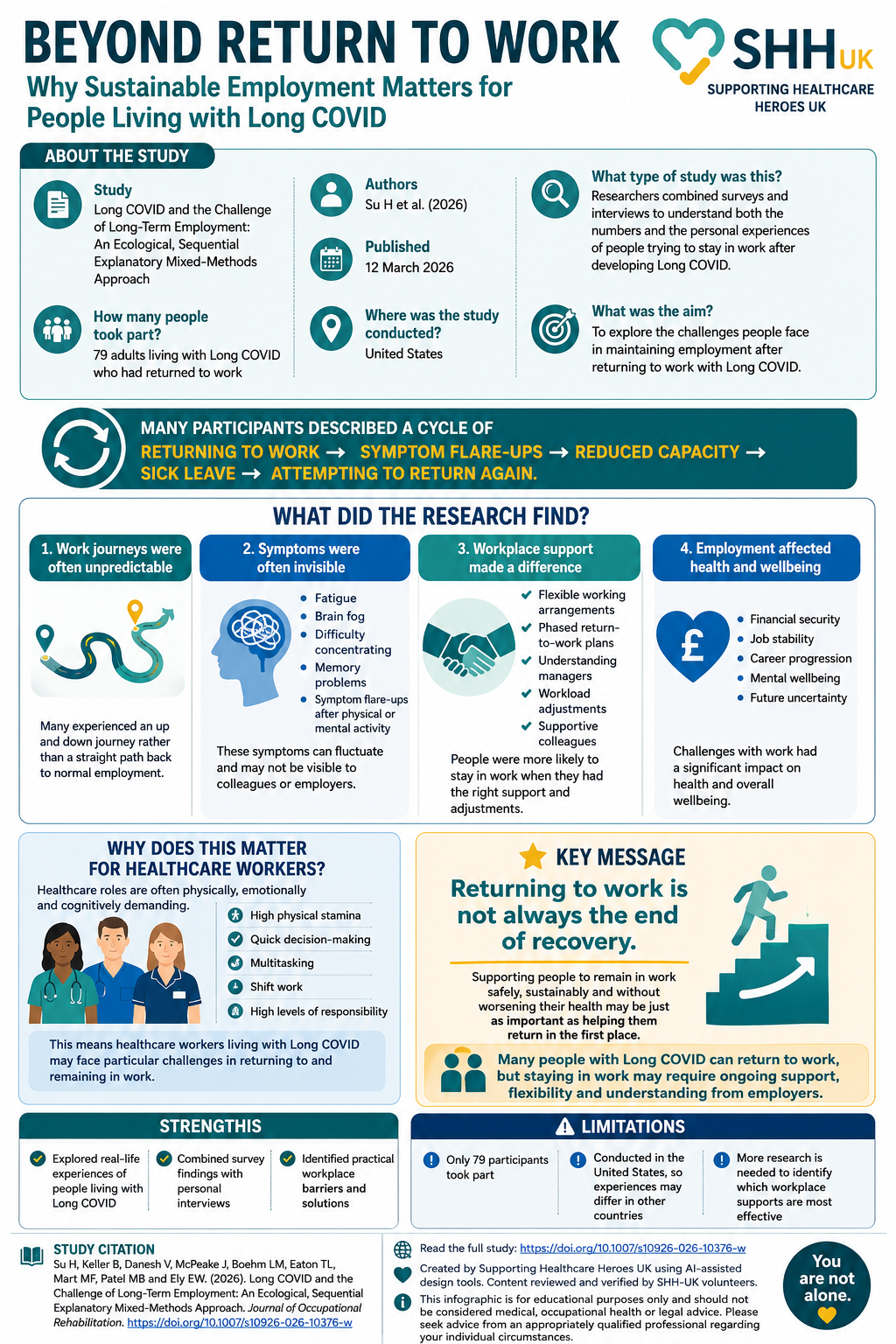
Returning to work is often viewed as a major milestone in recovery. However, for many people living with Long COVID, returning to work does not necessarily mean returning to their previous level of health. This study by Su and colleagues explored the experiences of 79 adults living with Long COVID who had returned to employment. […]
Learn why the precautionary principle is fundamental to infection prevention and how its application protects healthcare workers and patients.