Pacing for Long Covid: Patient Experiences Studies
Category
Living with Long Covid
Share
A key strategy for managing post-exertional malaise and symptom exacerbation in Long Covid is to use pacing.
Two studies have explored the experiences of people living with Long Covid when using pacing. A mixed methods study in 2025 explored explored how non-hospitalised people with Long Covid experience pacing (energy management). A second study carried out online interviews with people living with Long Covid.
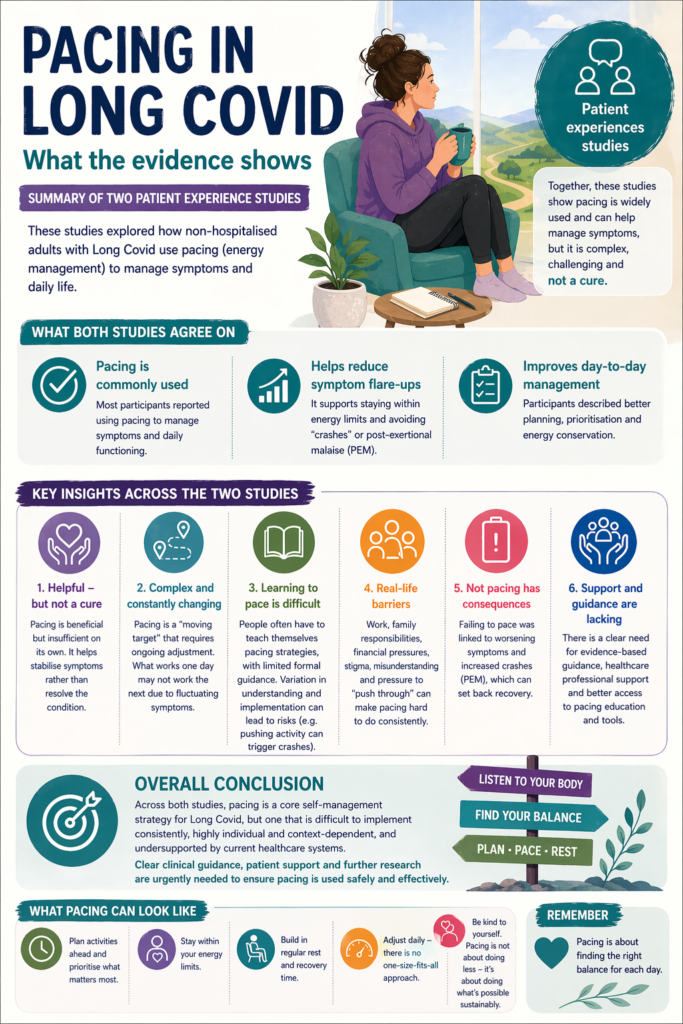
Below is an infographic detailing the findings of the two studies followed by a more detailed written summary.
Summary of the evidence from two studies
What this means for you
Pacing can help manage symptoms, but it is not a cure
It requires ongoing adjustment based on your energy levels
Doing too much can lead to symptom flare-ups (“crashes”)
Support and guidance on pacing are often limited
Key takeaway Pacing means working within your limits – not pushing through symptoms.
Combined summary of findings
Together, these two studies show that pacing (energy management) is widely used by people with Long Covid and can help manage symptoms—particularly post-exertional malaise (PEM)—but is not straightforward to implement and is not a cure.
Key insights
1. Pacing is helpful – but not a cure
Participants consistently described pacing as beneficial but insufficient on its own.
It helps stabilise symptoms rather than resolve the condition.
2. It is complex and constantly changing
Pacing is experienced as a “moving target”, requiring ongoing adjustment.
What works one day may not work the next due to fluctuating symptoms.
3. Learning to pace is difficult
People often have to teach themselves pacing strategies, with limited formal guidance.
There is variation in understanding and implementation, including risks from inappropriate approaches (e.g. pushing activity increases).
4. Real-life barriers make pacing hard
Work, family responsibilities, and financial pressures can limit the ability to pace effectively
Participants reported stigma, misunderstanding, and pressure to “push through” illness
5. Not pacing has clear consequences
Failure to pace was linked to worsening symptoms and increased crashes (PEM).
6. Support and guidance are lacking
Both studies highlight the need for:
Clear, evidence-based guidance
Healthcare professional support
Better access to pacing education and tools
Overall conclusion
Across both studies, pacing emerges as a core self-management strategy for Long Covid, but one that is:
Difficult to implement consistently
Highly individual and context-dependent
Undersupported by current healthcare systems
The evidence highlights an urgent need for clear clinical guidance, patient support, and further research to ensure pacing is used safely and effectively.
Download the full articles by clicking here and here.
Share your experience with pacing by posting a comment.