
Covid is Airborne: You’re breathing it in
A powerful short video explaining how COVID spreads through the air like smoke, highlighting why ventilation, clean air and respiratory protection matter.
Read more

Summary
Dr Curran warns nosocomial COVID control is failing, urging systemic reform, leadership, and Deming-inspired principles to prevent infections and protect patients.
This week’s blog is the eighth in a series from @EvonneTCurran.
I am beginning to think that there is no hope for the prevention and control of nosocomial SARS2 because the guidelines are wrong, mitigations are being removed and no one (in a position to do so – which includes Chief Nurses and infection prevention societies) is arguing for and promoting infection prevention. Clearly, we need to change the system.
Several years ago, I sustained a gash on my knee after falling on gravel. I arrived at an A&E, about 08:15, holding myself together and thankfully not in tears, but knowing I needed stitches – probably 4. My dress was dark, over my knees, and without obvious blood stain. It was fortunately quiet – just a few in the waiting room. I informed the clerkess of my diagnosis and of my latex allergy. Her response to the news of the allergy was that I could tell them that when I got inside… A nurse emerged and looked me up and down. “So, you need stitches.” (Clearly, the self-diagnosis had not gone down well). “Yes, I think so.” I responded. “Well show us you knee then”. She asked. I wanted to ask if the trauma was to my bottom would she want me to drop my knickers in the waiting room – but resisted. I left 4 stitches later. This was an A&E in Glasgow where there were always ‘challenging patients’. But nevertheless, the waiting room was not a place for ‘show and tell’. The approach used for ‘challenging patients’ did not need applied to all. And it struck me then that some portion of the A&E’s staff time should be spent in areas where ‘challenging patients’ as a proportion of the total was much reduced. Relentless encounters from challenging patients appeared to have taken its toll.
I think that we could now apply the same principles to Covid Decision-Makers (CD-M)* involved in removing mitigations against nosocomial covid. There is a need to step back, for an absence of covid issues, to engage external review, to update the Situation Awareness in healthcare. Some CD-M have perhaps been in the battle zone for too long with inadequate resources and viewing the crisis shift-to-shift rather than with long-term goals. They want out of the war whilst the battles of safe patients’ placement and perpetual staff shortages are still raging. The battle for patient and staff safety might already be considered lost. Who can blame them for never wanting to hear about covid again. Their problem relates to the National Infection Prevention and Control Manuals which subsumed separate COVID guidance into a few lines in 2022. Since then, there has been:
I’d want to give up too. This is a crisis. As Deming said, “Best efforts and hard work not guided by new knowledge, they only dig deeper the pit we are in.” Edwards Deming successfully took on the role of improving manufacturing in Japan after the war. Japanese companies became way more efficient than American ones under his guidance. Finally, the US companies turned to him to get them out of their production crisis. In his book, Out of the Crisis Deming put forward 14-points to transform American Industry. As he says in another book “A system cannot understand itself. The transformation requires a view from outside.”
I have adapted Deming’s 14-points to get us out of our covid crisis. This is my view from outside.
Now, where are any of the leaders who can change the system.
*I have hesitated to use the generic term ‘manager’, I have known many excellent managers during and before the pandemic who have gone to great lengths to prevent and control infection. I have avoided this term and gone for Covid Decision-Maker – to refer to those who seem unable to see the harm that will arise from the removal of mitigations especially for the clinically vulnerable.
A powerful short video explaining how COVID spreads through the air like smoke, highlighting why ventilation, clean air and respiratory protection matter.
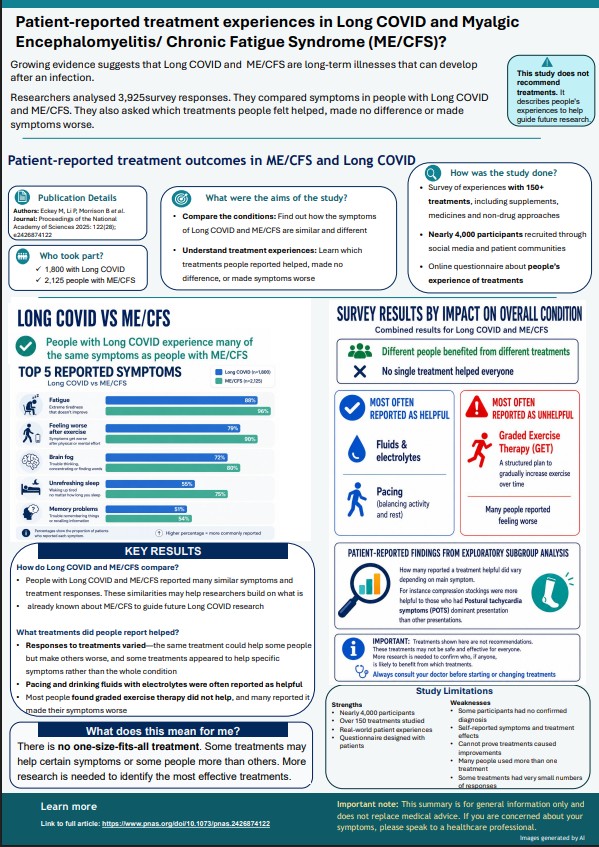
Explore this SHH-UK Research Summary of a study examining patient-reported symptoms and treatment experiences among nearly 4,000 people with Long COVID and ME/CFS.

N95 and KN95 respirators may look similar, but they are certified to different national standards. Both are designed to provide a high level of filtration, with each rated to filter at least 95% of specified test particles. (Smart Air)